
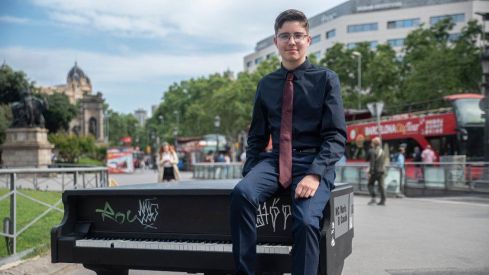
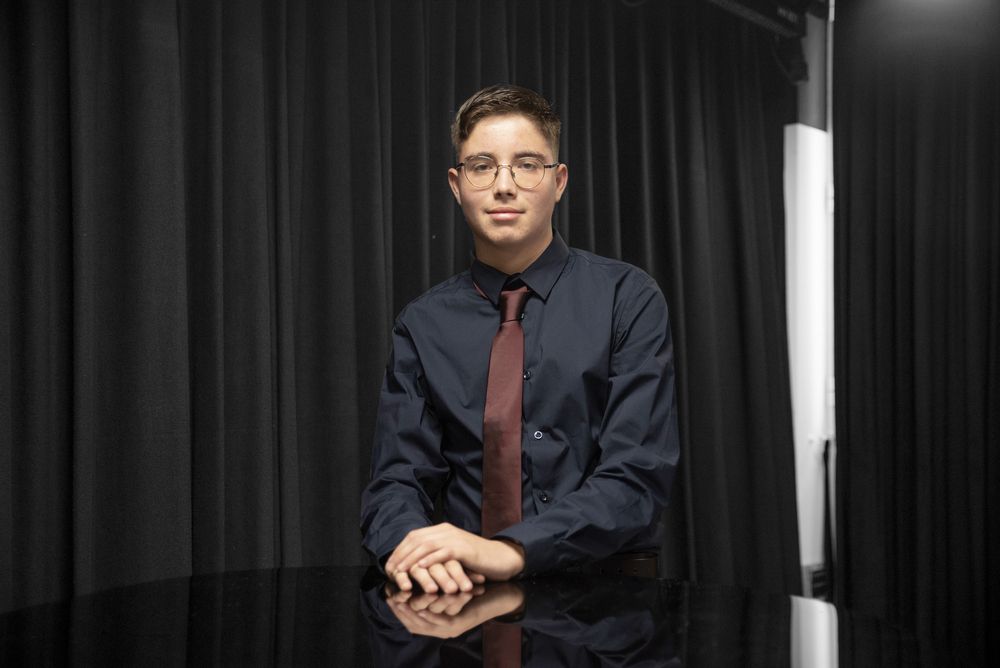
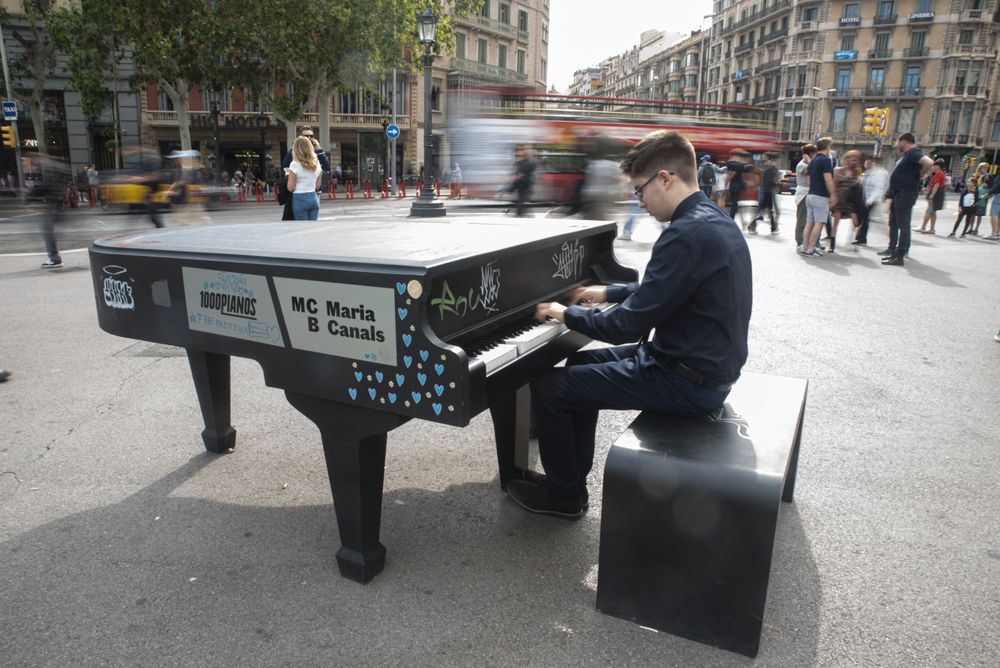
An easy and well-worn way, and a classic of journalism, would be to say that Álvaro Esteve is a kind of Messi of the piano. But it would probably be too simple a resource, and also pretentious and unfair to him. Esteve is currently 14 years old and is a talented young pianist. He lives in Ciutat Meridiana, in the Nou Barris district of Barcelona, and interviewing him means discovering a teenager whose musical instrument is at the center of his life. When he explains himself, he combines doses of shyness and security that generate a very good balance. All this, under the watchful eye of parents devoted to their son's passion.
You were able to take your first steps in the world of piano thanks to a program that the Maria Canals Foundation and the Jesús Serra Foundation ran in disadvantaged neighborhoods. This was when you were in first grade. How do you remember the beginnings of playing this instrument? You were six years old.
My tutor, in first grade, when we were working, since I finished very quickly and started bothering my classmates, one day she asked me if I wanted to play the piano. And I said yes.
So you started playing the piano so you would stop bothering your classmates…
Yes. I started at a school near mine, Mestre Morera, one day a week in the afternoons. There were two students. Then I moved to Allegretto, in Joanic. There I had Irina Pocheckina as a teacher, Stanislav Pochekin's wife. I was there for two years, and then I went to Marshall, where I stayed for very little.
And how do you remember the moment when the school teacher had the idea for you to play the piano?
I remember it being a bit of a drag [laughs]. But I thought: let's give it a try.
And beyond that first thought, did you like it right away?
I really like playing the piano. I like the things I do well, and when I saw that I was doing well and progressing, I liked it more and more. Then at home we bought a small digital piano and I would study until dinner time.
So, one of the first things that made you like the piano was that you were good at it from the beginning.
Yes, more or less. But I don't like it just because I have a knack for it, but because it's beautiful, its sound... It has so many things.
Was the sound one of the things that hooked you the most?
When I was little, I didn't think about it much; that's a more recent thing. Back then, I liked it because it let me let off steam. It was like passing the time.
From what you say, playing the piano was like an escape route…
Yes, and as I grew older I became more aware of what the piano was, its mechanism…
You soon had a great teacher, Irina Pochekina, whom you have already mentioned. From a very young age you were accompanied by great professionals. How do you experience having top-level people training you? Does it put pressure on you or do you like it?
A little bit of both. I feel pressure to play well, but I like it because I know I have a good teacher. I'm comfortable with it. I've always had good teachers. Last year I had one who wasn't so well known, Fedor Veselov, who had been with the great pianists of Russia.
Talent helps you, but if there's no dedication you won't achieve what you want
I guess one of the keys to learning is having fun. It's important to enjoy yourself while playing the piano.
Yes, I have fun because sometimes I play, but I don't think. My muscle memory plays, but it plays well [smiles]. And sometimes I run a little without wanting to because I get excited. There are precious passages that can be fast, slow... Or even choral. Now I'm playing Beethoven's trio number 1 and there's a choral in the middle that is precious.
It's lovely how you explain these exciting moments. It must really strengthen your bond with music.
Yes. I spend many hours a week listening to music at home. I have a mini stereo and about 20 records, and I listen to almost all of them. Some I don't because there are composers I don't know and I don't really like their music, but most of them I do.
You were saying that sometimes you play from muscle memory, that you speed up too much, that you get emotional… These are examples of what you experience. But how do you think people experience the music you make when you've done concerts?
Normally, when I play I'm very focused on the piece. If I play a wrong note, for example, and the concert ends and I've only played that one wrong note, I'm thinking about it the whole time. I say to myself: "Oops! They'll think I play badly."
That means you're very perfectionist.
Yes. And I think people have a good time at my concerts. I've done quite a few, and they always ask me for another song. Last year I did an encore, but I didn't know any [laughs].
Now that you mention people having a good time, what kind of pianist do you consider yourself to be?
When you're at the piano, you have to sit as if you were sitting down to eat. Both legs on the pedals and play. A little expression with the body, yes, but not doing too much, because that's more like theater.
You are, to put it somehow, from the classical school.
Yes, I suppose.
Going back to your career, at the age of nine you already accessed professional studies and were immediately proposed for the Esmuc Júnior project. That's what you call moving fast. How do you remember that moment?
I remember my father telling me that I would play at Esmuc, and I didn't know what it was then. I knew who Adolf Pla was, who taught me classes. It was a pleasant experience. And at the end of each course, they made you do a survey where you had to say what you wanted to improve, and I said that I wanted to do musical languages.
Did you notice that you needed to better understand everything you were learning?
Yes. It's interesting when you analyze a work in depth, because you don't see the whys, but you know how to do it better, express yourself better, look for the meaning of the sentence... And then everything is more complete.
In some of your performances, you can make what you do seem easy.
No... At home, I mainly study the passages that are most difficult for me. But I don't think about whether it's easy or not. I spend hours playing, and there's no other secret.
Now that you mention it, you dedicate many hours to the piano. I suppose that effort and hours are non-negotiable to continue improving. Talent alone doesn't get you everywhere, does it?
Exactly. If you have talent, it helps, but not that much. If there is no dedication, you won't achieve what you want.
My idol is Daniel Barenboim. And also Beethoven
From what you say, sometimes talent can be a double-edged sword.
Yes. In fact, a few years ago I spent a summer without playing much and I got a little worse. I told myself that I was already good... And I saw how I got worse, which made me have to refocus.
Picking up on your career path, where do you think it will lead?
I want to go to the Esmuc [Catalan College of Music]. And, besides being a pianist, I want to be an orchestra conductor. If I have to do two courses at the Esmuc, I will. I also want to go to Germany, and before that I think I'll go to Madrid, to the Reina Sofia. But I'm clear that I want to be a pianist and orchestra conductor and go to the Esmuc.
You seem convinced and ambitious.
Yes, but there's still a little way to go. I'm in fifth grade now, and at 15, I can't get into Esmuc. It's a shame because if you can do something at 15, you should be able to do it.
You could see yourself doing this jump now.
Yes, because next year I'll be in sixth grade and I'll be finishing with 15 years.
You'll need to be a little patient...
Yes, even though I don't have much...
You were telling me earlier that when you're at home you listen to a lot of music. A good part of your life has to do with the piano…
Yes, I listen to music whenever I can, and when I go to school or come here to the conservatory, I also listen to pop music, for example. Not reggaeton, I don't like it at all. I prefer music from the 80s and 90s.
Do you look at historical or current names to have them as a reference? Is there any recording or artist that has marked you?
My idol is Daniel Barenboim, and also Beethoven. When I discovered Daniel Barenboim, I experienced the feeling of how you can like something, but you don't quite know why. It was like a kind of desire.
Now that you were talking about when you go to school, is it easy for you to balance your training as a pianist with your daily life? Your routines must be a bit different from the rest.
It changes a bit. When I have homework, obviously I have to do it. I do it at home as quickly as I can, but well done, and I go to study piano. Although some afternoons I can't do it because I have a lot of homework or I have to study for exams.
How many hours do you dedicate to studying piano?
During the week, about two hours daily, and on the weekend I study in the morning and in the afternoon.
And at school, what's your favorite subject?
Social Studies. Because I'm good at it...
Like the piano.
Exactly [laughs]. And also because I have a teacher, Albert Serra, who gives interesting classes. And he likes me. I have an IQ of 124 and my mother warned him. He's a bit more focused on me so I don't get bored and stay engaged. I also like Social Studies because I really enjoy geography. History not so much, but also. When I was little, I remember having a mobile app to learn the capitals and flags of countries.
To wrap things up, I wanted to ask you about your neighborhood, Ciutat Meridiana, in the Nou Barris district of Barcelona. At the beginning, we said that it all started because you're from there. What does your neighborhood represent to you?
Ciutat Meridiana is a beautiful neighborhood, but sometimes you also experience episodes that aren't good. If we talk about music, there's not much... There's the Vozes school, where they teach guitar and violin classes.
So, surely without the Maria Canals Foundation project you wouldn't be where you are now…
Yes, I think it's fair to say I've been lucky. It was all thanks to my school teacher and the scholarship that Maria Canals gives every year.
I also listen to music from the 80s and 90s. Not reggaeton, I don't like it at all.
Have the times you've performed in Nou Barris been special?
For me, all concerts are the same. At the end of the day, it's about playing as well as possible and trying not to make mistakes. But it's not like saying "Oh, I'm home." I feel that when I'm at home alone studying in my room.
Now that you mention that the music scene in Ciutat Meridiana is almost non-existent, would you like to get involved in some musical project in the neighborhood in the future?
Well, now that you mention it, yes, definitely. When I grow up, I would be delighted to carry out such an initiative. It could be a school, even if it was very small. And if it served to bring a smile to a boy or a girl, it would be fantastic.
To complete this interview, we speak with Bernat Padrosa, the director of the Trémolo school of music and performing arts.
When we talk about Álvaro, what kind of pianist are we talking about?
If we focus on the school, Álvaro is the student who has stood out the most both in terms of precocity and hard work. The best thing about him is not that he has many qualities, more or less innate, but that he is a student who works hard and studies hard. And this means that he is evolving very quickly. If we focus on Catalonia, one indicator might be the Esmuc program for young pianists, and he was one of the youngest. So here's another indicator. We could say that in Catalonia he is in the Top 10, to give you a headline. Then, if we look at Spain or Europe, it's another story. The most important thing is that he likes it, he dedicates himself to it and that there is a talent that we must take care of.
We were just discussing it with him, that beyond talent, the hours of study are fundamental.
Yes, he is not leaning on his talent.
That's interesting what you say, because before you were telling me that there was a summer when you leaned back a bit and noticed how it got worse.
Exactly. Obviously, there will also be times when you have to have fun with other things, go out... But everything is compatible.
And what is it like to manage someone like Álvaro, who despite being very young has already won important awards?
Well, you have to manage him as if he hadn't won any, like a normal student. What we have to try is for him to have musical challenges. And with respect to what is done with him and not with other students, well, for example, a few months ago we met with his parents to try to arrange a couple or three of concerts that we organized from here. Or move him from the third year of language to the fifth directly.
Bernat Padrosa: "The best thing about Álvaro is not his innate qualities, but that he works hard and studies hard"
You advocate for a learning approach that is highly focused on the student's profile and their reality as a musician. In Álvaro's case, what does this mean?
We see that he is a student who needs challenges. Right now, for example, with his piano teacher, we have signed him up for a competition and a forum at the Esmuc for pianists so that they would let him play. Ultimately, trying to support him and for him to see that, beyond the classes, things are happening.
How would you like his career to evolve?
Just the fact that he ends up being what we are fighting for him to be, a pianist and orchestra conductor, would already be fantastic. And if, in addition, he can come here in a few years and teach us things, that would be... The moment a student of yours teaches you something means you have done a good job. The ideal of a teacher is that your students surpass you. Let's see if one day we organize the 'Álvaro Esteve Masterclass'.


