La Capella, located in Barcelona's Raval district, has just inaugurated three new exhibitions. La Mancha más ciega, by Ana Martínez Fernández (Cantabria, 1982), and Totxana, by generative artist Heeey (Xavier Lozano, Barcelona, 1987), belong to the Barcelona Producció 2026 program, and the third exhibition, Llenguatges materials, by Loana Flores (Buenos Aires, 1987), is part of the Concèntric program, in collaboration with EART, Centre de mediació, educació i art contemporani.
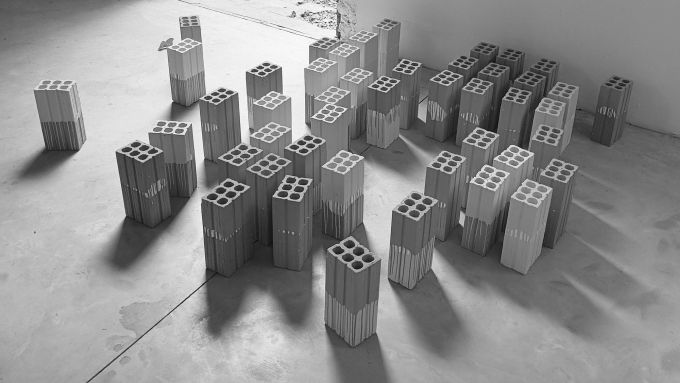
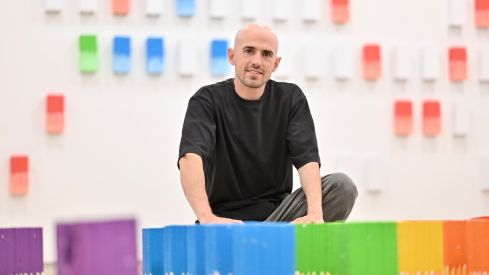
As for the Barcelona artist Xavier Lozano, artistically known as Heeey, he presents in the Rampa space a work that unites housing and algorithm "to speak of our bodies forced to move". Born in Barcelona in 1987, he is a generative artist who creates art through code. His practice focuses on the creation of generative algorithms that produce unique visual pieces each time they are executed. An architect from ETSAB (2012), he combines his digital practice with sculpture made from construction materials. In addition, both in digital and hybrid pieces, interaction with the attending public and their participation are a constant in the formalization of the work.
Heeey masters the algorithm as matter and thinks creatively through it. He works with systems of rules, instructions, and computational processes that produce variable forms each time they are executed. In this case, this logic leaves the screen and meets construction materials, as on other occasions it has met stone and, now, brick. The work invites the public to manipulate the space and become the algorithm that manipulates the sculpture.
In this sense, Totxana dialogues with the tradition of conceptual art and with artists such as, for example, Sol LeWitt, for whom the idea, the instruction, and the procedure could be as important as the material form of the work.
From this simple gesture, the sculpture begins to change. The work is defined by the interaction between the algorithm and the visitor. The initial form of the sculpture progressively unravels, like a community when its inhabitants are forced to abandon their homes, their support networks, and their daily routines. Totxana thus becomes a city that appears and disappears, a forced landscape subjected to rules that directly affect the bodies that inhabit it.
Ana Martínez Fernández and Loana Flores
Regarding the work of Ana Martínez Fernández, the artist has developed research around the expansive quality of sculpture. In La Mancha más ciega (The Blindest Stain), in collaboration with the Wood Passport program of Estructuras3000, she continues this research using a single material: industrially manufactured self-adhesive vinyl printed with a photographic pattern that reproduces wood planks. Although this vinyl is usually used to homogenize, protect, or embellish surfaces damaged by use and wear, by adopting it as if it were a modeling and architectural composition material, the artist emphasizes the illusory quality of the material and the failure of the decorative effect with which it was produced.
In the Chapel's lobby, the exhibition Llenguatges materials (Material Languages), by Loana Flores and curated by Gisela Chillida, brings together a constellation of biomaterials developed from organic waste and discards. Initiated in 2018, this expanding material archive presents an open field of possibilities, materials that retain the memory of their origins and that, through experimentation processes, acquire new forms, textures, and potentialities.