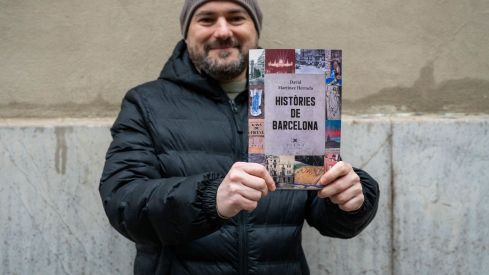
David Martínez (Barcelona, 1977) is one of the best-known authors when it comes to explaining curiosities and stories of Barcelona. His account on X –formerly Twitter– @historiesdebcn accumulates more than 53,000 followers, and in recent years has become one of the most popular references in historical dissemination on social networks. Now, after more than seven years searching and sharing the most singular and forgotten episodes of the city online, Martínez publishes his first book, Històries de Barcelona.
How is it that you make the leap to paper?
Actually, before social media I started with the blog Històries de Barcelona in 2018, even though it was already a time when they were declining. But the fact of having it, which in a way already has this format of telling slightly longer stories, allowed me to easily jump to paper. Afterwards, the proposal to make a book came to me, starting from an idea similar to that of the blog, but in a format that wasn't too far from social media. That's how it was born.
What exactly can we find in the book?
The idea is for it to be a journey through the history of Barcelona, from the beginning –with mammoths– to current times. It does so based on specific episodes, anecdotal facts, and curiosities that can be placed in each historical moment. It also represents all of Barcelona and a bit of each neighborhood, and these are stories that are not very well known or that sometimes are only known in the academic field. Furthermore, they are ordered chronologically, although it is not necessary to read it in one go: the idea is that you can jump from one chapter to another.
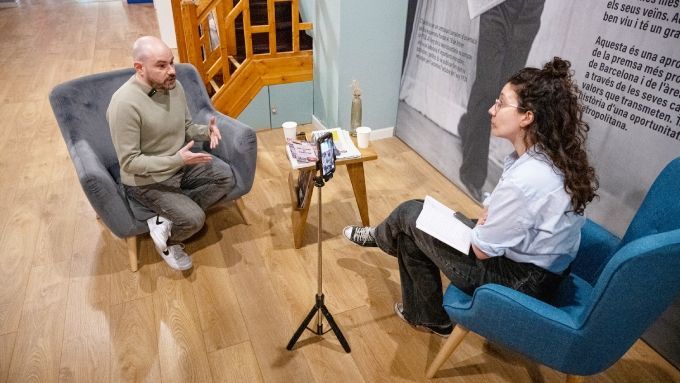
You started the blog more than seven years ago. After so much time, are there more stories to tell?
Yes, of course. When I started, I made a list of topics and, in fact, in the book I have left many out because they require more time to go visit archives, talk to people or search on the ground. For now I have a bunch of note sheets of, perhaps, between 300 and 400 pending topics.
How do you manage to find so many?
Pulling one thread leads you to another. When I look for photographs in the newspaper archives, I find others that are also interesting. Furthermore, Barcelona is a city that is constantly changing. Recently, the history of the Roman forum was re-evaluated, for example. Some archaeologists had already suggested it, but now archaeological evidence has been found. That is to say, there is always some finding that leads to a new discovery, and this is because Barcelona is a city in constant transformation. Stories never end, especially the small and most curious ones that have not yet been told.
In the prologue you state that you have compiled stories of Barcelona that have not been told entirely well.
Yes. The one that I find most amusing is that of the Barri Xino, a name by which the lower part of the Raval was formerly known. It was called that, not because there was a Chinese population, but because a parallel was drawn between this area of Barcelona's underworld with “people of ill repute”. The origin of the expression is attributed to the journalist Paco Madrid, because he used it for the first time in an article from 1925. But searching the newspaper archive I found that this expression was already used much earlier. The thing is that the invention of the term has been attributed to him –even the journalist himself said so–, but it is probable that he heard it from the people of the Barri Xino themselves. These are things that happen a lot in dissemination: perhaps everyone draws information from the same source and, sometimes, it is possible that it contains errors due to oversights. And the problem is that it is repeated until someone verifies it.
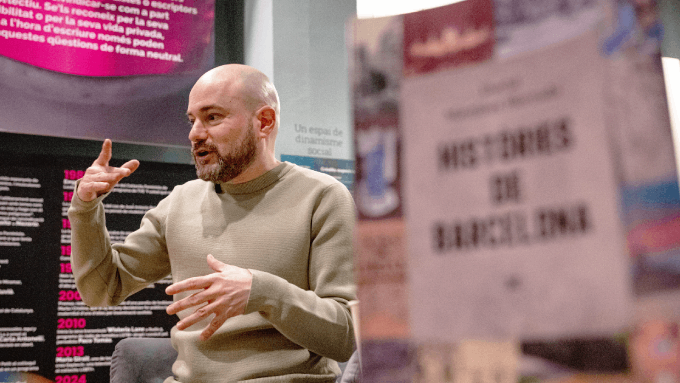
And how do you ensure that everything you explain is true?
I always try to cross-reference it with many sources, but sometimes the oldest part is much more complicated than the last two centuries. Well, I'm sure there must be some error in the book and that perhaps there will be someone who has lived it and tells me: “No, that wasn't exactly that way.” Or also that, as we mentioned a moment ago, I might have used a source that has some mistake.
Have you ever been corrected?
Yes. A while ago I wrote an article about the light fixtures of the Palau Nacional and I took the information from a book published by the City Council where certain technical aspects about the power of the fixtures, which, obviously, I don't control, were also detailed. Shortly after publishing it, a man who had worked with the architect Carles Buïgas –who designed the fixtures in the seventies– and who carried out their maintenance, wrote to me. He told me that what I was explaining was not correct. That's why I always try to find as many sources as possible.
You do a historical dissemination task, but you are not a historian. Do you think it's an inconvenience?
It's a complicated topic [laughs]. I don't sell myself as a historian, and I greatly respect those who do research, because that's where I drink from. But it is true that, in Barcelona, traditionally there have been figures of journalists –today in extinction– who explain the history of the city from social chronicle. I think, for example, of Lluís Permanyer, who is one of the best known, or of Sempronio. I am in this field and I don't think it's a contradiction. Nevertheless, I understand that there are historians who look at it with suspicion, because from journalism sometimes sources are not well contrasted or are not explained. I try to be respectful and say where I found each thing and what is the source behind it.
Mammoths, unknown neighborhoods, macabre fountains… The book covers many topics and from all districts, but which story surprised you the most?
There are several, but the one I like the most is that of the Montjuïc spotlights that were made in 1929, for the International Exhibition. During the years of the Republic they projected the colors of the senyera, and in the seventies a series of tests were carried out to do it again, but since the red color was not illuminated enough, it was abandoned. All this was forgotten, and in the 2000s it was not known exactly if it was a real story or an urban legend, because even though there were photographs, they were in black and white. But then I found a color photo of those tests and, therefore, it was like verifying a part of it. In addition, with the newspaper archive we were able to finish certifying the story.
When telling the story, the point of view with which it is done is always important. What do you think yours is when you talk about Barcelona?
Wow, I wouldn't know how to say it [laughs]. I don't know if it's considered a point of view, but for me it's the most demanding part of the heritage. Maybe I'm annoying and there are people who take it as an attack, but, unfortunately, a lot has been destroyed in Barcelona. And not only with Porcioles (mayor of the city between 1957 and 1975), but with all the governments that have come after and of all colors. When I ask for the protection of something, it's because they are considered emblematic elements with historical value. And it's not a political criticism, but simply a wake-up call. Right here, for example, on Girona street, we have the tram rails that for a long time entities like the Transport Museum have been asking the council to place a plaque there. But it's not a matter only of this government and not even of the District: for a long time it was also demanded from the previous City Council and it will continue to be insisted upon with the next one. In the end, it's a problem that is becoming eternal, and it seems to me that heritage is forgotten until it falls. And, when it does, then we lament because "it is too damaged".


