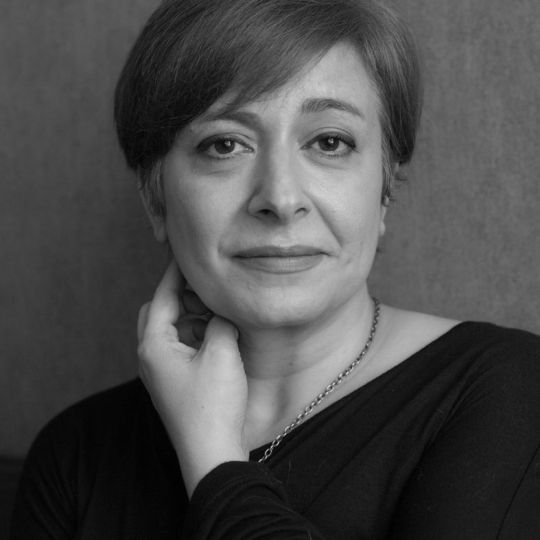
None of Mahsa Mohebali's books can be published in Iran, her native country. The prestigious writer has been subjected to constant pressure and surveillance by Iranian security forces due to the critical nature of her work. She is now exiled in Catalonia, specifically in Ribes de Freser, together with her husband, Hossein Zoghi. He is a journalist, theater director, and actor. His career has been marked by the prohibition of his texts against the regime. Zoghi was banned from official theatrical activities in Iran. For four months now, both have been part of the international reception program Artists at Risk, which is based in Barcelona through No Callarem.
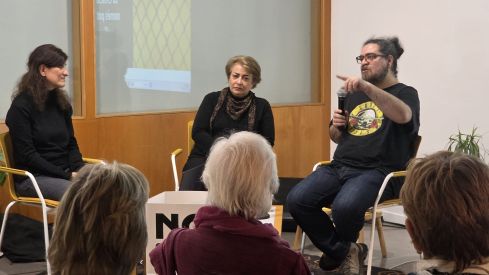
Even though they live in Ribes de Freser, they do a large part of their cultural life in Barcelona. We speak with the couple before this Thursday afternoon they hold a colloquium at the Centre Cívic Ateneu Fort Pienc where will be screened, within the framework of the Cicle Cinestèsies, the documentary El dia de la poma, about the suburbs of Tehran. In addition, they are creating a theatrical show, El Pou / El Cos, about the resistance of women in Iran, written by her and directed by him. It is not yet public, but it can be seen in May at Sala Beckett. “Artistic resistance in Iran is very important”, they comment throughout the interview.
To begin, could you introduce yourself as a journalist and writer?
Mahsa Mohebali: I have been writing since I was 16. I studied music at the University of Tehran and later returned to literature. I have published five books in Iran and have written several screenplays for films. In recent years I have had many problems publishing my works, and that is why I have done so in Afghanistan. During the last year I have lived in Iraqi Kurdistan, from where I requested the Artists at Risk residency. They gave us a stay in Barcelona for six months.
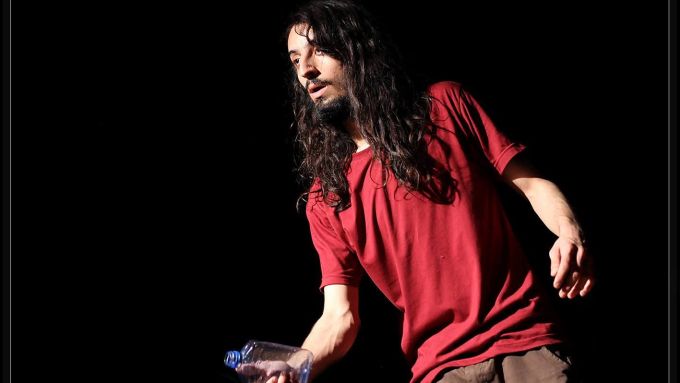
Hossein Zoghi: I studied theatre at the University of Tehran and have worked in many public theatres in Tehran as an actor and director. But, in 2009, after the post-election protests, I switched to doing underground theatre and mostly worked in friends' apartments. I needed money to live, and that's why I started working as a journalist.
Now the people of Iran believe that they can fight against the government
What works do you have in hand with the Artists at Risk program?
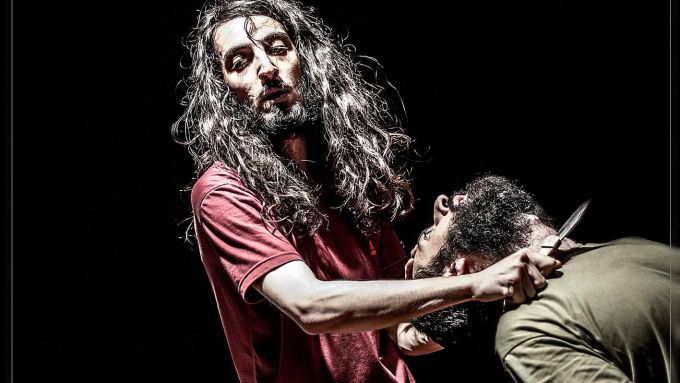
H.Z.: Now it's fantastic to be here, because when we were in Iran they didn't let us work. Especially Mahsa, because they forbade her to publish her books, write, speak, and teach. Now we can do anything freely. Mahsa has written a theater script about the resistance of Iranian women and from all over the world and I will direct the show at the Beckett. We have done it thanks to No Callarem, which will produce it. Now I also write for some newspapers.
M.M.: I am finishing a new novel and I am starting to write a book based on my diaries. We are very comfortable in Ribes de Freser. Also, we have made many friends!
How are you receiving the news from your country these days?
H.Z.: March 8 was a horrible day, as Israel and the United States attacked Iran's oil facilities. The country's sky is apocalyptic. It is dark and it rains oil in Tehran. Everyone is scared, but life goes on. I have heard friends say that the current war is a little better than the previous ones, because people are more prepared. But in reality, it is still a war…
M.M.: I believe that Iran is in a new situation. Mojtaba Khamenei, son of Ayatollah Ali Khamenei, is the new supreme leader of Iran. We hope he is not as crazy as his father.
Do you have family and friends in Iran?
H.Z.: All my family and friends are there. They have cut off the Internet: it's the government's hobby every time it has problems. It already happened two months ago. I have been able to contact one or two friends and I have spoken with my mother once, because she called me, but only via the Internet, since international calls are very expensive. They are scared by the sound of the missiles. My mother has now moved to a village in the north of the country, because my brother has had a mental illness for years and needs to be in a quiet place. Despite everything, they are fine.
M.M.: I have been following up on a writer and poet friend of mine, Yousef Ansari, who is in prison because he was arrested in January. Before they cut off the Internet, I was in contact with other friends who were trying to get him out of prison, but now I don't know what has happened. It worries me a lot, I hope he can get out. All prisoners in Iran right now are in danger, because they have no food or any kind of attention. It's horrible.
Why did you leave Iran?
H.Z.: We decided it after the Twelve-Day War [it began on June 13 when Israel launched attacks against dozens of Iranian targets to stop the expansion of Iran's nuclear program]. We were very scared to leave home. It was horrible, because it was a war in the city. The planes, the drones, the missiles… They were going to Tehran and it was terrifying. You didn't know where they would fall. We only went out to buy necessary things, like food and water. It's hard to think that both she and I have spent our lives in war. We have lived through so many protests in 20 years… It's a terrifying life.
M.M.: When we were nine years old, the conflict between Iran and Iraq began. Therefore, we have already lived the experience of a war, but the following generations have not, and that is why many were paranoid and in shock during the Twelve-Day War.
Today Thursday participate in a colloquium about the documentary by the Iranians Mahmoud Ghaffari and Mahnaz Jarchim. They made it after the death of Mahsa Jina Amini, in 2022, which provoked massive protests with the movement Women, Life, Freedom. The presentation of the film at the Berlinale led to the exile of the director and the screenwriter. How has Iranian society changed since then?
M.M.: After the '79 revolution, there was a lot of repression, especially against women, who cannot ride bicycles, go to the football stadium, dance, sing… And they have to submit to many discriminatory Islamic laws. Since then, women have fought against inequalities. They were not always large demonstrations; often with everyday resistance. For example, they started wearing the headscarf a little further back until they let it fall. But when that happened to Mahsa Amini, women got really angry. Even the older ones took it off and went out into the street to say that, if this could kill a person, they would not wear it again. If we see many people in the street these days, it is because Amini's case was a key moment for women's movements in Iran and around the world.
Do you believe that this movement led by women and young people has changed the relationship between society and the regime?
H.Z.: The regime has not changed. The issue is that there was a young generation that assumed their rights as customs. As Mahsa said, it is a daily resistance.
M.M.: The government arrested young people for not wearing a hijab, cancelled their bank accounts, their SIM card and took away their car. In response, there were women who paid every day whatever was necessary. They cannot fight against women every day, and that is why the government backed down.
H.Z.: One of the benefits of the women's freedom movement is the courage it has provoked in people. Now the people of Iran believe they can fight against the government.
“If Europeans focused on the theocracy and fascism of Islamic rules in Iran, they would see that the country lives the same fascism that Spain and Italy especially lived”
Let's talk about the European reading of the conflict. Many conversations tend to analyze Iran mainly through geopolitics. Do you think that citizen perspectives are sometimes missing in this discussion?
H.Z.: I think so, because Europe's point of view is conditioned by the conflict between Israel and Gaza. They believe that the government of Iran is not bad because it supports Gaza and is against Israel, but the people of the country know that the government is a monster. Iran has been at war with the United States and Israel for 47 years. Europe should see it from the point of view of human rights. Our government is a monster, and you cannot negotiate with monsters.
Now that you say that, in Europe, the conflict between Israel and Palestine generates enormous media attention and public mobilization, especially in support of Gaza. Meanwhile, the Iranian struggle has received much less mobilization for years. How do you interpret this difference?
H.Z.: The only important thing for the people of Europe now are Gaza and Israel. Why didn't Europe support Iran two months ago, when 30,000 people died in the street? It's strange. Unfortunately, some Iranians living in Europe and the United States carry the flag of Israel at protests. I don't support that, because the government of Israel is also a monster. I believe that Europeans should see things correctly and support the people of Iran, who have suffered under the Iranian government, which has killed many people. If Europeans paid attention to the theocracy and fascism of Islamic rules in Iran, they would see that the country is experiencing the same fascism that Spain and Italy especially experienced.
M.M.: It is necessary to separate the people from the government. We are in the same situation as Gaza.
How do you see this foreign intervention and international pressure, considering that the regime has accumulated decades of repression and brutality in Iran?
H.Z.: Before Israel and the United States attacked Iran, many people, like me, agreed with a foreign intervention, because we deeply believed and believe that we alone cannot overthrow the Islamic regime. In January and February, Iran showed that it can easily kill people, but the world was not talking about it. Now, after the military intervention and so many bombings and missiles, people are starting to worry about Iran. On the other hand, I believe that now is the time when governments, especially European ones, as Pedro Sánchez has done, should disagree with the war and force the Islamic Republic to stop it, to listen to the people of Iran and to make the government fall so that it leaves. I am not a politician, I don't know how it should be done, but I know that our people are under an enormous war and under a brutal government and regime. And all governments and people should stand with the people of Iran. For a government to show itself against the war is good, but a solution must be found.
In Iran there is the life that is made inside the house and the one outside
To conclude, I would like to talk about the social divisions within Tehran. El dia de la poma talks about a family from an economically marginal area of the city. Are there differences there regarding support for the regime compared to middle-class areas?
M.M.: I would say that in 2010, when people demonstrated for the re-election of Mahmud Ahmadinejad, it was indeed an intellectual and middle-class movement. People from the poorest areas did not participate much, as they voted for him. But now it is different. I have friends who live in the suburbs and are very angry. Many of the people who have died are from the periphery of Tehran. Economic pressure affects these people above all. Prices have risen a lot and they are under enormous pressure. I believe that now everyone has united: the rich, the middle class, the peripheral neighborhoods, the intellectuals, the students… Everyone is angry because they believe there is no hope within the system.
H.Z.: Unfortunately, the people of Iran have no power. Many people are against the regime, but others are like a grey shadow and do not want to talk about the situation. Nevertheless, people see what a brutal government they have through videos on social media, bodies on the ground… Reformism in Iran does not work. We have tried it for four decades. The current president of Iran is a reformist and also kills people.
Finally, what do you think Europe misunderstands about Iran and Iranian society?
M.M.: There is a very important thing: in Iran there is the life that is lived inside the house and the one outside. At home we drink alcohol and have a free life like in Europe or the United States. But outside the house it is different: everyone seems religious, prays… When Europeans see these images, they ask themselves: ‘Why are you like that?’. It's because it's different. Even our gestures are: we cannot kiss in the street, we cannot hug… Outside we are others, it's like a mask. And I believe that this difference is often lost when talking about Iran.
H.Z.: Yes, and it is difficult to understand, especially because of the censorship and the propaganda of the regime.