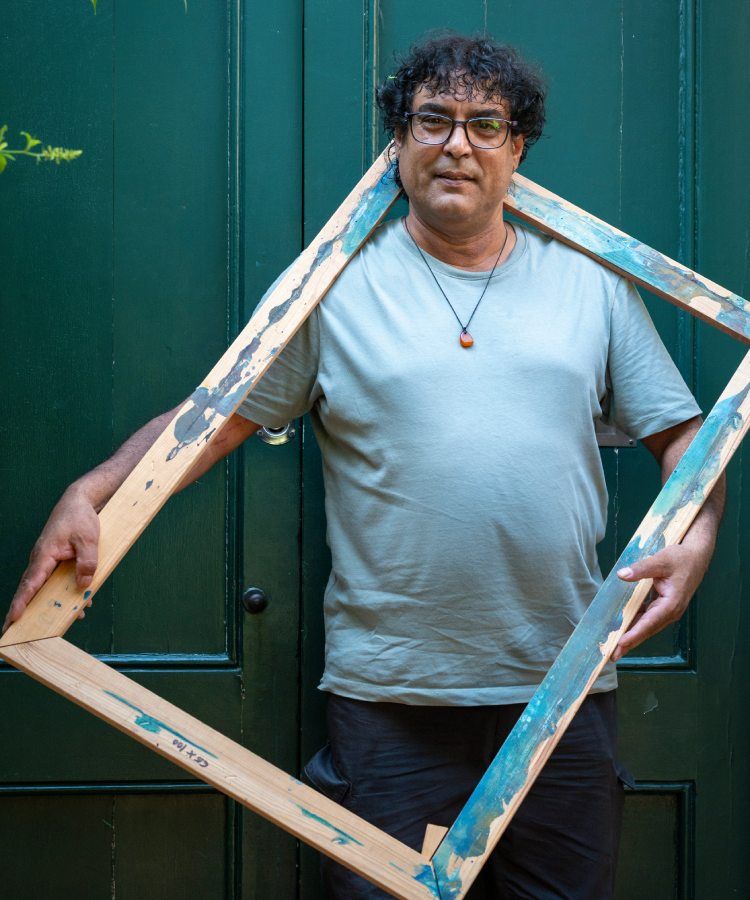
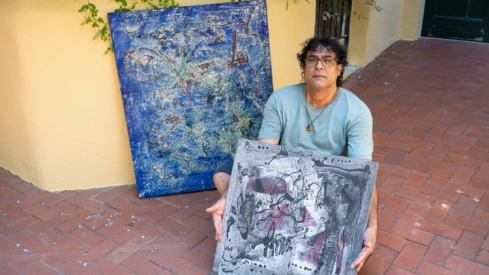
The story of Manolo Gómez Romero is one of those where the script, at the very least, can be described as interesting. Born in rural Seville 57 years ago, he ended up living in Barcelona after meeting his wife, Joana, on a plane. A love story that led him to become part of a family of great Catalan artists, such as Josep Llorens Artigas, Mariette Artigas Gardy, and Joan Gardy Artigas. He, a painter, also has big names in his blood family, as he is a cousin of the Gypsy 'bailaora' Juana Amaya. Surrounded by all these personalities, Gómez Romero could be someone interested in fame, but it turns out he is quite the opposite.
You're from a small town in Andalusia, El Coronil. What do you remember from your childhood?
I remember that I was a very happy child. It was a tough time, but even so, I was happy. My mother's family was from El Coronil, while my father's was from Morón de la Frontera. They are flamenco people, who sing, dance, and play. I, however, am an atypical gypsy. I can't sing or dance. I like to listen to music, though. I find that it has a lot of impact on human beings.
And when did your interest in painting begin?
I was very little, and I remember my mother painting the walls with lime, because in Andalusia at that time it was widely used for painting. I saw drops falling and it caught my attention, because they were drawings. When my mother hung out the clothes, there were transparencies, and in the shadow it made, I saw drawings.
So, you were a child with an artistic sense…
I think I did it unconsciously. I always told my father that I would have liked to know how to sing, dance, and play an instrument, but he would reply that the most important thing was to study and know how to be in the world, and that the rest would come.
Now that you mention your mother and the lime, in El Coronil almost all the houses are white…
Over the years, I've seen that the contrast of colors with the terrain of that area, because that's the Sevillian countryside, is what gives you the depth. There, you see everything in the distance. The white, the blue, and the different browns are only found in nature.
Geography conditions you and defines your artistic perspective…
Exactly.
With what you're explaining, can we say that your mother was the first artistic figure of reference you had?
She always told me: "Boy, don't make dolls." Because I would ask her for the paintbrush. Everything was for playing, which is the most important thing. The boys and girls who play at being painters are doing what is most important.
Now perhaps it's harder to see images like that, because there are so many screens…
Yes, but deep down you can't go against a society that evolves. Obviously, I don't like screens and I believe in other stories, but it's their world, not mine. I'm closer to the end than the beginning.
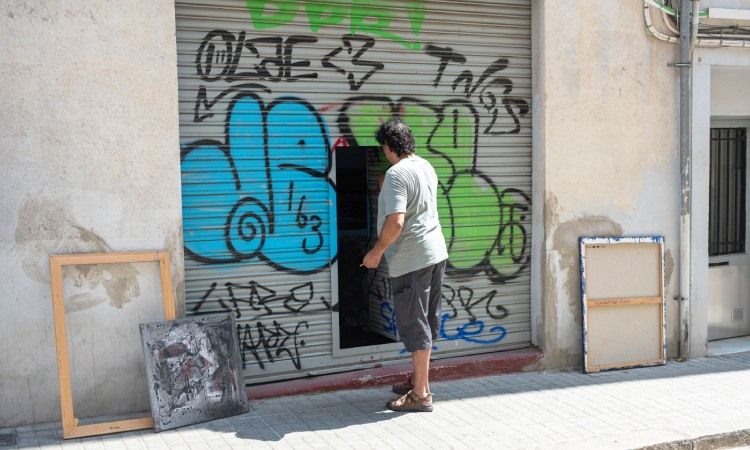
You arrived in Barcelona in the late 80s. How did you end up here?
I never thought I would live in Barcelona. I took a plane from Palma, where I was living then, to Malaga. And I met the woman who ended up being my girlfriend and later my wife. I told her about Malaga, Seville... She told me that she had been to many places in Europe, but not to El Coronil. And it turns out that a woman who cared for her grandfather was from there. And she came, and we are still together to this day.
She is part of a family of great artists. Her grandfather was Josep Llorens Artigas, and her mother, Mariette Llorens Gardy. That is, your mother-in-law, who unfortunately passed away recently. Josep Pla said of her that she was one of the great women of the country…
sHe was a person of great stature. I loved her very much, but she was also very hard on me. One of the first times we went to an exhibition of a very important painter was with her and her godmother, who was the daughter of the sculptor Pablo Gargallo. We were in Paris, and they spoke an artistic jargon that I didn't understand. Later, one day, Pierrette Gargallo told me that if I didn't understand that jargon, I would never become a painter. Two years later, in Paris, I proved that I knew more, and she said to me: "Well, now go downstairs and look, there might be Gargallos that haven't come onto the market."
And what did Mariette say to you?
She never talked to me about white with black or blue with yellow… She would tell me: "This is shit." And also that we would talk when I did something important.
But he must have detected that there was talent, right?
It's like having to polish a diamond. What was the story? From Miró to Barceló passed through his house, because he knew a lot about art. And he always emphasized that his name would not be used for me to stand out, but that the family would help me when they thought it was the right time. He made me investigate for 10 years. I didn't study Fine Arts, but I have visited the studios of great painters.
You had to work very hard…
I remember that at one point I wanted to study and make stained glass, and she would tell me that I had to look into the art of Portugal, or into who knows where… She would gently drop what she considered important, and I, subtly, would gather the information.
Painting has a lot to do with architecture and mathematics
Another important figure from that time was Joan Gardy Artigas, Mariette's brother, a prestigious sculptor and ceramist who is currently 87 years old…
Yes, Joanet. And also one of his sons, Isao. I've always had great admiration for Joanet.
Now we're in Sarrià, where you have your studio. What was the contrast like when you arrived in Barcelona compared to your origins in Andalusia?
They are two different worlds. In my case, both of artists, because both my family there and here are. If you visit Andalusia and Barcelona, or Catalonia, they have nothing to do with each other. Neither better nor worse, but very different.
And now, after so many years, how would you define your relationship with Barcelona and Catalonia?
It’s very good. I have great friends here and I feel like I’m from here, from the neighborhood. Before, when I came, I was always on the outside, but now I live a neighborhood life in Sarrià, where I live and have my studio.
And the roots you have in Andalusia are deep…
I have my great childhood friends there. Friendship is very important. True friends, they say, can be counted on the fingers of one hand, but I can't do that.
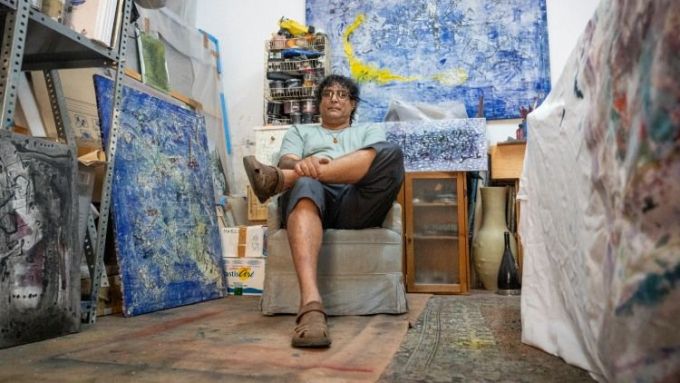
Here, you held your first exhibition in 1991, precisely at the Josep Llorens Artigas Foundation, in Gallifa. It must have been very emotional, especially for the family…
Look, I'll tell you an anecdote. We were in Mallorca and I told Joanet that I wanted to paint the song in an abstract style. And he replied: "Very good. What you're telling me isn't strange. Abstract art is very old. Primitive man already painted in this style." And he told me that he had confidence in my work.
Did you have doubts?
My thought was that, even though we were family, I didn't have the level to exhibit there. And he, being very Taurean, told me: "The die is cast." And he emphasized that it had nothing to do with me being the husband of Joana, my wife and his niece, but he made it clear that I would exhibit because he liked how I did it. And I was a bit like this... For me, it was very powerful. They all trusted me. Because there's always that thing about being "the young one of" or "a relative of."
The art world thrives when black money is moving.
Now that you were talking about the abstract style, do you define yourself as an abstract painter?
I started painting bullfighters, and I was comfortable with that, but I felt like I was missing something, so I gradually changed my style towards abstract painting. But it's also true that even now, at 57, I still feel that way, and I've been painting for 35 years.
Your paintings remind me of Pollock…
Yes… Dripping – the dripping, the technique of action painting –. The Gypsy is an anarchic, different being, and this style reflects that.
Does your identity transmit to the painting?
In my painting, I seek a lot of movement, but also for it to be balanced.
An order within this anarchy you were just talking about…
Well, it's just that painting has a lot to do with architecture and mathematics.
Art is becoming a very snobbish thing. There comes a point when only the name matters.
But is there a Gypsy identity?
Painting is painting, there's no such thing as paya [non-Romani] or Romani painting. When you mix blue with green, it doesn't matter who does it. But it turns out that I am Romani and my painting has connotations because of this fact.
And within these connotations, what is the influence of flamenco on your work?
There's a lot of it. Flamenco is freedom, creation… And at the same time, it's also very rigid. And my painting is like mixing all of that together.
The order and anarchy we mentioned earlier, it's also in flamenco...
Everything has to have a structure.
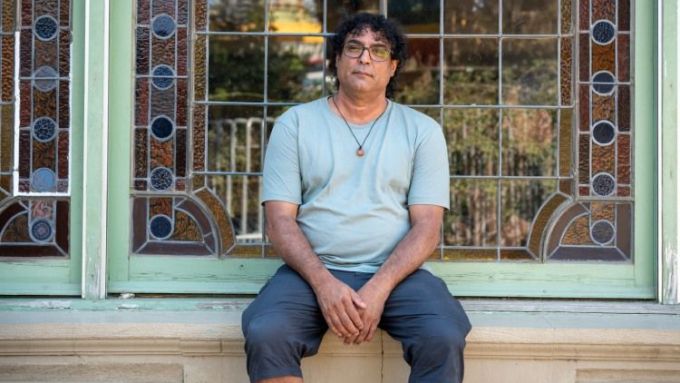
Do you think that all this experience you've accumulated has been sufficiently recognised here?
The recognition is all the same to me. What matters is that I feel good inside. What others think… Let them think it.
And in this interior have you managed to feel good?
There are times when I'm painting, yes. When things come out. And when they don't, frustration appears.
But frustration is part of the process, isn't it?
Exactly, it's key to making a painting. You're never completely happy. And you have to know when to leave it, and let it breathe.
Now that we were talking about recognition, in 2012 you were given the National Roma Painting Award. What did that mean to you?
It was a recognition for my people, for my community [gets emotional]. It was in Madrid, at the Reina Sofia. And in 2023, they gave me the Amico Rom award, which is the oldest in the world dedicated to the Roma people.
Beyond what you said about recognition not interesting you, awards also give solidity to an artistic career, right?
Yes… What happens is that there are people who only live for awards. I live my life.
This trajectory that you have been accumulating has also led you to the Kai Dikhas gallery in Berlin, which specializes in giving visibility to the creativity of the Roma minority…
She's the first in the world to do this. When you're Roma, you have to break down many barriers. At first, they always look at you with distance.
Why is there still a racist outlook?
Yes, I think so. Gypsies are the largest ethnic minority in the world, with twelve and a half million people. And in Spain, we are also the largest ethnic minority. Gypsies are looked at in a specific way.
“I’m an atypical gypsy; I can’t even sing or dance”
Maybe it would be good to have a space like this here too. Beyond music, artistically, very little is said about gypsies…
Yes, here, much more visibility is given to the musical aspect than to painting, literature, sculpture… But it must also be clear that, in order to exhibit, there must first be training as an artist. Sometimes it seems that exhibiting is like throwing an egg in a pan, and it's not. Be careful with that.
You always strongly advocate for effort and discipline as a fundamental part of an artistic career.
It's just that rushing isn't good. A fruit falls from the tree when it's ripe, not before.
Returning to visibility, here, in important spaces such as the CCCB or the MACBA, there is often much talk about different minorities from many places on the planet. However, little is done about the Roma… Do you see it that way too?
It's just that gypsies are invisible. The great gypsy artist Helios Gómez, who has exhibited at the Reina Sofia, is ignored here. Neither him nor others, whether from before or now.
There's a lot of focus on the external minority, but perhaps not on the internal one.
Yes, it doesn't exist. From gypsies, music attracts and little else.
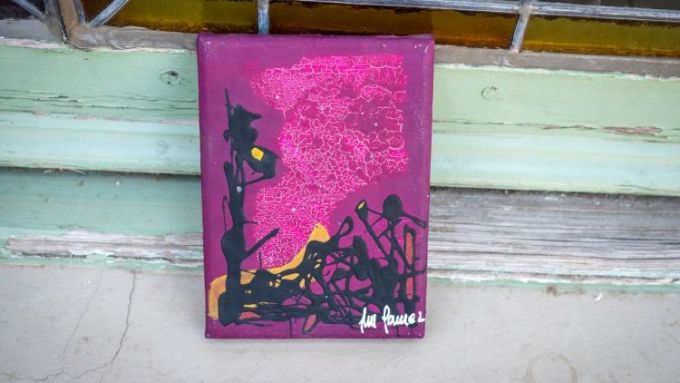
His first exhibition in Barcelona was in 1991 at the Josep Llorens Artigas Foundation, in Gallifa. Photo: Joanna Chichelnitzky
Looking at the European map again, last year you almost reached what could be called the summit. You made an appearance at the 60th edition of the Venice Biennale of Contemporary Art. Big words, right?
I never thought I'd make it. When they proposed it to me, I was scared, I trembled. I was very happy, but my wife, who is my representative, and Mariette, my mother-in-law, told me that we had to bring something that would make us proud. It was quite a challenge, because I wanted to do new things and they wouldn't come out, and I only had six months. I dreamed about the painting, I thought about what I could do... And it didn't come out until the fourth one. And I brought a work, two meters by one meter, Rroma Lepanto, which refers to the naval battle of Lepanto, where you can see a ship with a gypsy flag, since the rowers on one side and the other were gypsies. There were so many deaths that the sea was stained red, so I thought there had to be many spots. And in the background of the painting there is a gypsy woman who is a witch who directs the ship. And as for the colors, there is black, because it is the purity and strength of the gypsies, and white, which is elegance. The Battle of Lepanto represented a before and after for the gypsies and also for me.
And were you satisfied with how it went?
The work, yes. And 135,000 people passed through the palace where we were in six months to visit the exhibition. But you know what happens? That art is becoming a very snobbish thing. And there comes a time when only the name matters. And if you have one, you can do whatever you want, because that already has value.
"When you're Roma, you have to break down many barriers. At first, they always look at you with distance."
That was last year. Looking ahead, where do you think you can go artistically?
I don't know, because I'm not a fortune teller. If I had a ball... They say that gypsies can predict the future, but it's a lie [laughs]. I live in the moment.
And how would you describe the current moment?
In general, in art, there's a crisis. The art world thrives when black money is circulating. The artist is the one who gets paid the least, because there are the gallery owners, the representatives, the photographers… Everyone gets their cut. And, about myself, I always say that I'm not an artist, that the title is too grand for me, but rather a painter's assistant. I have seen and known true artists and they have taught me and helped me mature. And, returning to the present, we must be aware of what is happening.
I suppose you're referring to the European political landscape. The extreme right is growing, hate speech is on the rise… How do you experience all of this?
The far right is arriving all over Europe, and that is very bad for ethnic minorities. We only need to remember that during the Holocaust, half a million Roma were killed. And now we are seeing the genocide in Gaza, what Russia is doing in Ukraine… In Africa, there are also very serious conflicts… Genocide is inherent to the human being.
And from the artistic world, what can be done against all this? Does culture have the power to combat a moment like the present?
I think so. In fact, the only way to change the world is through culture.