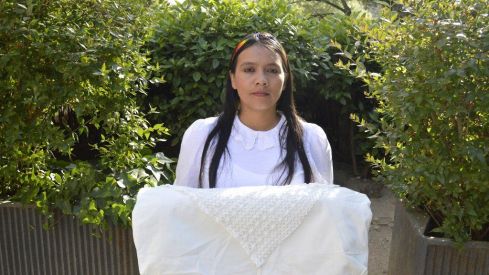
To write a play in a language you don't completely master is not done overnight. There must be, without a doubt, a will behind it. Who has done it recently in our language is Eddy Laverde, actress and theater researcher. She, who is Colombian by origin and Santcugatenca by adoption, explains that it has been “a whole process”, since when she arrived, three years ago, she began to learn Catalan first to integrate and then to make a place for herself in the Barcelona theater sector, which she sometimes considers hermetic.
The author, as she explains, wanted to create a show in Catalan to “reclaim the language” and for this reason has written Ñucanchi, accompanied by Josefa Mora and Camila Sanint, members of the company Abya Yala, formed by other migrant women from Colombia who also live in Sant Cugat. “We also come from territories where the language has been lost,” explains Laverde.
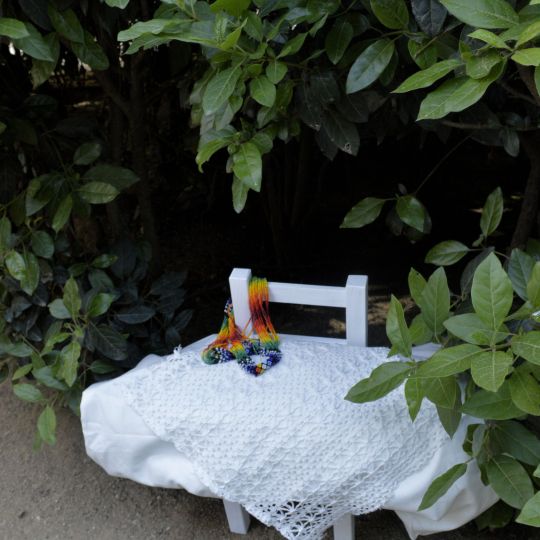
Ñucanchi is a work that interrogates theatre, from the essence of the Pachamama divinity and invites to a ritual encounter, with ‘Nucanchi Llacta’, which means ‘Our Land’ in Quechua language.
Recently, they have premiered the play at the Ateneu del Raval and next March 27, coinciding with International Theater Day, they will perform it at the headquarters of Òmnium Cultural of Sant Cugat, with one performance at 17 h and another at 19 h.
In Catalan to climb professionally
Choosing Catalan has been linked to a linguistic awareness that he hopes will materialize in job opportunities, since until now he has had to move through alternative circuits, especially due to the history of his shows. "To the small venues in Barcelona like Tantarantana and that have more media resonance, I haven't arrived due to many dynamics of the sector, such as the fact that the theme of migration sometimes doesn't interest," he laments.
Laverde's previous work was Yuyay, which means memory in Quechua language and that “was a monologue in homage to Catalan and Colombian culture” through its history. It also included some parts in Catalan.
This show has moved in recent years through venues in l'Hospitalet, Barcelona civic centers and to the recently disappeared theatrical space Periferia Cimarronas de Sants, dedicated to Afro-descendant theater.
In fact, this week, Thursday, March 19 at 1 p.m., it presents Yuyay at the UAB Theater Hall, in Plaça Cívica, a fact it celebrates, as works have been performed there that later made the leap to Barcelona. Tickets can be reserved for free here.
However, Laverde currently combines theatrical practice with her doctoral thesis dedicated to La Calòrica, a theater company from l'Hospitalet that in recent years has catapulted itself onto the main Catalan stages. This research, as she says, has motivated her both to learn Catalan and to get to know the cultural ecosystem of Barcelona and l'Hospitalet up close. In this sense, the creator shares that they are preparing the materials to circulate Ñucanchi through Barcelona theaters.
“To be closer to the people”
A couple of years ago there was a controversy, and which is surely a pending issue to resolve within the sector, which revolved around the fact that large Barcelona productions like the musicals La jaula de las locas or La tienda de los horrores, by directors Àngel Llàcer and Enric Cambray, were in Spanish to attract “more audience”. This is how Llàcer summarized it three years ago on the program Cafè d’Idees: “If we did it in Catalan, fewer people would come. If you don't create a Catalan society that doesn't speak Catalan, it's not our problem”.
Asked how she sees the situation, Laverde has a clear answer: “You can do the work in Catalan and then translate it into any language. Furthermore, Catalan is not only spoken in Catalonia. I have colleagues in the profession who live on the border with France where it is also spoken, and that way we don't always do the works in Barcelona. Because if not, Catalan will be lost.”
Catalan can be a temporary barrier at the beginning, yes, but that does not justify not learning it
The author adds that there is an intangible element in this matter and it is the linguistic proximity that is created with the public of Catalonia: “It is clear that the works must be able to circulate, but they must be done in Catalan to be closer to the people. Evidently, there must be a clear will behind all this.”
Do you think language is a temporary barrier for newly arrived artists like you? “I think at the beginning yes, but that doesn't justify not learning it, especially when Catalan resembles Castilian. It's not an obstacle. If you arrive at a place and they have that language, you must immerse yourself in the culture and do it in Catalan. If a company wants to enter the Catalan theater circuit, that's what there is,” he concludes.
About Eddy Laverde
Laverde is Colombian and a theater researcher. She has lived exiled in Sant Cugat for four years after having suffered daily harassment for months for having denounced the murder of her younger brother, who disappeared one day before the Estallido, a cycle of civil protests against the government of Iván Duque.
The judicial process that she started together with her family put the Colombian woman in the spotlight in 2021. The harassment escalated when they started pursuing the students of the theater classes she taught in a humble neighborhood of Bogotá. That's why she decided to contact a human rights association that recommended her to leave the country.
After that nightmare, the actress explains that little by little she has rebuilt her life. The theater, her passion since she was little, has helped her.