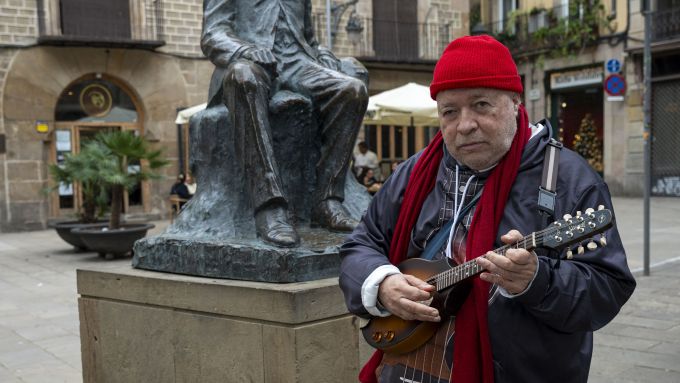
The idea was to take a walk along La Rambla de Barcelona with the artist and ramblero Quico Palomar. We meet him near his home, in Portaferrissa, but he has many problems walking and we don't feel up to making him parade among the fences, the machinery and the potholes that have made –temporarily– La Rambla more inaccessible than ever. He suggests we take a quiet walk towards Plaça del Pi, one of the places where he used to perform on the street in the good old days. We go there.
Quico tells us that the Rambla of the seventies, his favorite, was much more than a street or a promenade. It was an atmosphere; a way of being that manifested itself when you wandered through the “Gothic Quarter, the Chinese Quarter, the cabarets…”. “In any corner you could find the sheriff or Ocaña”, he recalls. “The Rambla of the seventies was a lung; a center of Barcelona life. We met people from all over Catalonia and other places there”, he evokes with longing. “I sang and sold my drawings, and everything was full of people selling things”, he adds. What remains of all that?, we ask him innocently. “Camels and whores”, he replies harshly.
We make a stop at a nougat shop on Petritxol street. A girl offers samples to passers-by. It's free, but Quico insists on exchanging a piece of nougat for a joke. She laughs hard and lets him choose the sweet. He hasn't lost his humor, but he has grown old. "One of the problems I have is that I feel weak. I should always go with a cane, because I don't have strength," he laments, without complaining. "I don't live the life I should," he says. "I should walk more and run and jump, but, damn, I'm not a child anymore, am I? We should always be able to play like children do," he continues, smiling. We advance amidst playful tourists and Quico points out some of the places where he used to perform, like the Guitar Museum. But today he wants to take us to a special place.
‘If Adelita wanted’
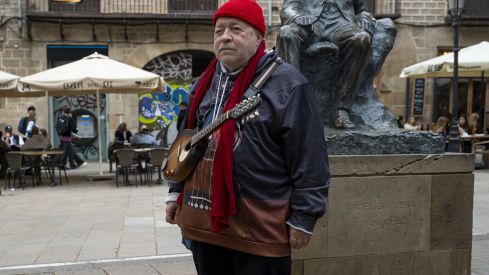
“The Plaça del Pi has always been a haven of peace from La Rambla,” he explains to us. “There was a very good atmosphere here. You always found young people with guitars there,” he recounts. When it's time to take a photo of him, Quico leads us towards the statue of Àngel Guimerà. He says that he took a very nice photo there, a long time ago. He takes his mandolin out of its case. “I also play the twelve-string guitar,” he informs us. “I really like exotic instruments and I've had quite a few. Historical ones, moreover,” he details. Held by the mandolin and dressed like the troubadour he feels he is, he prepares to sing us a song, even though we haven't asked him to. It's a classic: If Adelita wanted to be my wife.
His performance is surprising for most people who walk through the square and sit on the terraces. In another era, they would have gathered around him to applaud, sing, or laugh at him. Now they look at him out of the corner of their eye, not knowing what to do. That's why he has stopped performing on the street. “At my age, the image I project and the one I would like to project are no longer the same,” he admits with much philosophy. “But in Plaça del Pi I had performed a lot, and even on a stage,” he recalls.
And he was not acting alone, precisely. Here La Fura dels Baus began, of which Quico is one of the founders. “Right here”, he insists. “Then we were spontaneous, like the gypsies who always went with the goat, the trumpet and the ladder”, he compares. They started by doing the seal man, “a percussionist who put drumsticks up his nose”, and ended up parading with stilt walkers and jugglers. “We wanted to represent the medieval circus”, he recalls. Their paths separated when his companions from La Fura stopped being troubadours and minstrels and “turned punks”.
“A nice little boy”
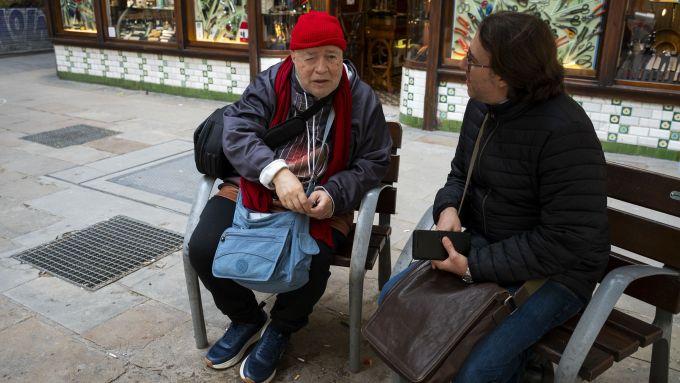
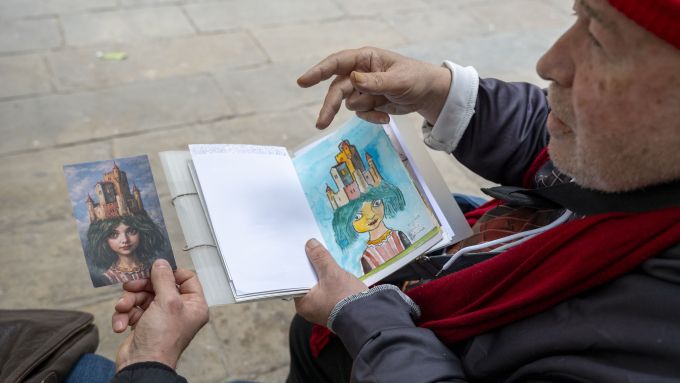
Quico is tired and we look for a bench to sit on. Quickly, he takes out a notebook and shows us his drawings. Before he sold them, "when I was a nice young man." Instead, now he says he is "a big man and that's over." "I sold photocopies of my originals for one hundred pesetas and then for one euro. I wasn't trying to get more money from anyone," he confesses. And it wasn't out of false humility, but for a more spiritual reason: "I wanted to demystify art and bring it closer to the people, but what I have demystified is my pocket." He painted murals in bars, held exhibitions and even built Viking ships, one of his passions.
The most incredible thing is that this old man, who explains to us one by one the drawings he keeps as treasures, then shows us his digital work. “With AI I take the drawings and make them move. Right now I have a project underway about the Montserrat mountain with my drawings in motion,” he tells us, as if it were nothing. Some can be seen on his Instagram profile and, if you trust him, he will send them directly to you via WhatsApp. They are very well made and certainly make an impact when you compare the original drawing with the final result, and when you know the artist.
“Selling drawings on the street doesn't convince me either. I'd like to do something else, but I can't think of where I can get the fucking money,” he laments. And he doesn't say it to get rich, but “to be able to create better, with more means.” “The other day I spent ten euros with a friend who taught me how videos are put together,” he reveals to us.
With great prudence we remind him that only recognized artists have large budgets. It comes to his mind to talk about Tàpies, to whom they “make so much propaganda”. “It's as if they gave the acrobats' prize to whoever walked over a line painted on the ground instead of going up there to risk their life”, he denounces. For him, painters are people who have a very delicate job and who have to concentrate and have to have imagination and knowledge: “And Tàpies tells you that a damaged wall is a painting and it's already artistic. And if you don't like it, it's because you're stupid”. And he continues, indignant, but without getting angry: “It's the story of the emperor who wore invisible clothes. I see the world like that child who made him see that he was actually naked”.
Quico and The Bourbons
We ask him if he misses any recognition and he reminds us of a claim by the rambleros that was made at the end of the promenade in 2010. He remembers that La Banda Trapera del Río and Pau Riba sang there. Jaume Sisa, no. President Montilla was also there, but as an institutional figure. “I did a few performances with a group I put together. We sang La Moños, songs by Lou Reed, some by Pink Floyd…”, he lists.
“La Fura dels Baus was doing medieval circus, but my companions turned into punks”, he/she says
Apart from his career as a troubadour, Quico has been in many groups. In La Fura and also in Santi Arisa's La Tribu. “Afterwards we formed a group called Els Bourbons. I was the Duke of Fiera”, he says. He suggests that we look on the Internet for a photo where they appeared with “balls this big and crowns on their heads”. They sang a mix of popular songs, in English and some reggae. But the leader had his things: “If he was angry, we all had to be angry”. “Ego is just another machine that exists in life”, he describes, “but if the swagger of maintaining one's own foolishness is stronger than the interest in doing something artistic, then we are not doing well”.
Our time is running out. Before he leaves, we tell him he is quite a character, but he says no. “I was,” he corrects us. “Now I don’t know what I am.” He bids us farewell with affection and goes home “to look at what’s left of the novel.” And afterwards he will still draw “for a while.”