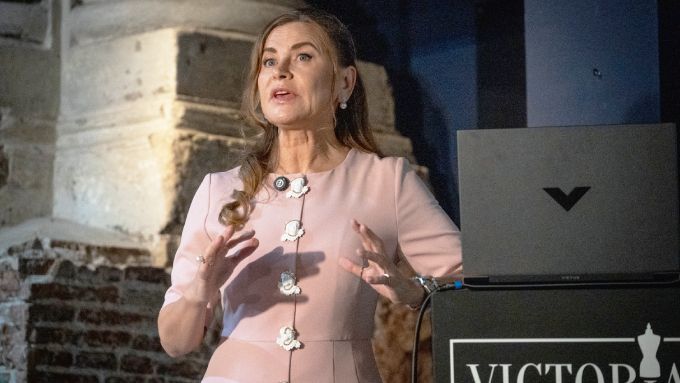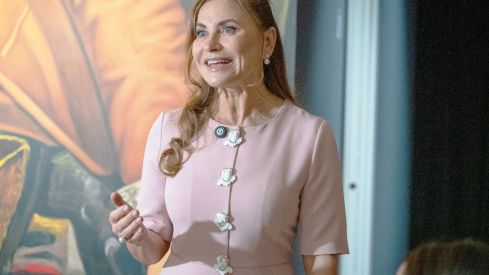
Victoria Lysenko has been working since she was fourteen, and by twenty-seven, she already had her own company in her home country, Ukraine. There, she founded a museum dedicated to her great passion: dresses. She arrived in Barcelona in 2022 fleeing the war, but here she has found much more than a refuge. Victoria has felt so at home that she has opened a branch of the Victoria Museum on Junta del Comerç street, the space she opened in Kyiv to champion the cultural and historical value of dresses.
Why did you choose Barcelona and the area around La Rambla to open your museum?
I didn't choose. Rather, Barcelona chose me. After the war began, nine months under bombardment, and a series of personal trials, I arrived here intending to stay only a short while, but the city wouldn't let me leave.
How long have you lived here?
Three years. Barcelona gave me the chance to see that even chaos can turn into art. It taught me to live again, to notice the beauty in the details of its architecture, and to accept its light and its shadow.
Quite a statement.
For me, it's a city where art lives, not just in museums, but also in the streets, where history and contemporaneity speak the same language. Here I felt I could unite past and present, feminine beauty, vulnerability, strength, and fear, through clothing.
And he chose the Rambla area precisely.
The Raval neighborhood also found me. The first time I arrived at the premises, on Junta de Comerç street, I arrived from the Liceu. It seemed like a good omen to me: the grand opera house and my future museum, just three minutes away.
And then?
The second time I arrived via a street with prostitutes and was offered drugs twice. Then the enthusiasm disappeared. I cried all day until I understood: the best place to open a museum is precisely where the greatest contrasts are.
There are indeed many contrasts.
It's a complex neighborhood, with drugs, homeless people, prostitution, and pickpockets. But it also has another side: old and beautiful streets, history, good restaurants, and, most importantly, local residents. Many live just above the museum and are Catalan. It's not a tourist facade, but a living urban fabric.
Why do you collect dresses?
I don't consider myself a collector. I am a museologist who has created a project from scratch. I'm not interested in trophies, but in living pieces. The memory of the body breathes in the fabrics. Movement, gesture, warmth are living testimonies of the past. The Victoria Museum is not a collection of historical objects, but a space for an inner journey, where people can remember who they are and perceive a living link with those who lived before us.
And when did you start getting interested in all this?
It all started with my interest in the history of 19th-century clothing. At first, I was lending a historic building in the center of Kyiv to international experts who were setting up their collections there. But in March 2014, with the start of the war in Donbas, I was left alone. Then I studied Museum Management in London, and in 2017 I opened my own collection, which today already exceeds 1,500 pieces. When the war hit again in 2022, I decided to keep the museum open as an oasis of peace for people.
You said that "the museum is a bridge between generations and countries." What exactly do you mean by that?
Kyiv and Barcelona have different contexts and energies. But the exhibitions speak of what is essential: human stories through clothing. In this way, we unite people from the 19th and 20th centuries. The eras are different, but the emotions are the same: dreams, love, hope, pain. This bridge reminds us that we have common roots.
Is the Victoria Museum a museum for tourists?
From the beginning, we have focused on the residents of Barcelona. In just over two months of operation, we have had almost 900 visitors, and only ten were tourists. Our museum is not about fashion, but about human dignity, about beauty as an inner state. It is a place to spend an hour in silence, surrounded by the clothes and scents of time. We all need this oasis, and residents perceive it especially. And yes, I want to believe that the museum can change the perception of the Raval. We all shape reality with our thoughts and actions.
What attracts you most to La Rambla and its surroundings?
It's the heart of the city. In a few meters, noise and calm coexist, tourists and old Catalan families, artists and street vendors, law and chaos. Today I understand that the museum had to be right there, next to the Academy of Fine Arts, the Liceu, the oldest market, and the first landmarks of the architect Antoni Gaudí.
It has been installed right in the middle of the promenade's renovation, in the midst of chaos.
After experiencing drone and missile attacks, sirens, and the death of people close to me, it's hard for a street renovation to scare me. Any renovation is a temporary chaos in favor of a future order. I am sure that once the works are finished, the Rambla will be even more comfortable, green, and harmonious. For the museum, it is an opportunity to integrate into a renewed cultural itinerary. We are here for the long term and we care about growing together with Barcelona.