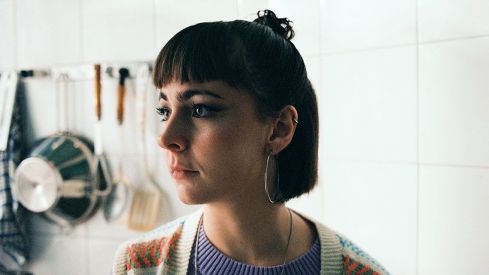
Olaia Inziarte (Oronoz, 1999) travels from her native Navarra to Sant Andreu de Palomar to transport the audience to her political, personal, and landscape imaginary. As the singer and composer explains, the concert she will offer this Friday, February 6th at l'Ateneu l'Harmonia (8:30 PM) will not only be an intimate exhibition of her work, but will seek, acoustically, a special and sincere connection with the spectators. Indeed, the concert promises to be a unique opportunity to discover from Fabra i Coats one of the most promising voices on the Euskaldun music scene.
It is your first concert in Barcelona this 2026 and in a community space like L'Harmonia. Does the project of this athenaeum connect with your way of understanding music?
Previously, I had done two concerts in Barcelona: a first in a small format and a second at Primavera de Ciutat, the cycle that takes place before Primavera Sound. Both were very intimate concerts: me alone with the guitar and four songs. About Harmonia, I had not heard of this specific place before nor how things work here, but for me it is an immense pleasure to be able to inhabit such spaces and contribute a little
You debuted solo in 2022 with Lehengo Lepotikan Burua, with a mix of folk and electronic in an intimate format, and you already received a nomination for Best Album in Euskera at the MIN Awards. How do you remember that beginning and how has your music evolved since then?
My music evolves at the rhythm my life evolves, naturally. I started without great expectations and I've had the luck, and also the work, that many good things have happened to me. However, sometimes it has been difficult to manage. Now I try to get the hang of it: knowing when to say no and focusing on what I want to contribute as an artist and what I want to say. I use music a lot as a channel to represent things that I believe belong to young people who live here and now in Euskal Herria, and to open doors
Is it complicated to respect your principles when everything goes fast and income depends on music?
Yes, totally. It's difficult to be coherent with your ethics and principles while paying bills, especially if you only dedicate yourself to this.
Has your Navarrese rural environment influenced your music? Has the incorporation of elements of the landscape or daily life been conscious?
As a young person I was more unconscious, but now I do it consciously. Not only on a communicative level (in Basque we speak differently in the north of Navarre than in Gipuzkoa), but I try to give voice to my way of speaking and writing Basque. I think it's important that where each artist comes from, the vital and historical moment they are living, and the place where they live, is noticeable
In 2025 you published Zerrautsa and then the EP Zura. How did you conceive them? Are they parallel, antagonistic ideas or do they intertwine?
More like the latter. Zerrautsa means sawdust in Spanish. When I built the imaginary of the album, I was going through a period of depression: everything seemed like a lie, I was angry with the world. I thought that if I wanted to continue making songs, they had to be tangible, rooted in the earth. I imagined a big tree that symbolized many things; to get the songs out of it, you had to cut the wood and also remove the sawdust (the not-so-beautiful things that don't remain in the final work, but that need to be extracted). I went for this dark concept, which suited my depression. Later, with Zura (wood), it was an expanded version but with more light and hope, once the necessary sawdust had been removed.
Your songs are very personal, but they also reflect your surroundings and political ideas.
Totally. There is a lot of self-criticism: we claim things, but we also have privileges that we take advantage of without realizing it. There are always things to improve and I try to point them out
Nowadays it is complicated to talk about genres. How would you define your current sound?
I don't know. There are many debates about what "music in Basque" is. There are Basque-speaking and non-Basque-speaking areas, a lot of immigration... If someone from Pamplona makes a song in Spanish or mixed, is it no longer music in Basque? I always write in Basque because I live in Basque in my town, in the north. In terms of genre, I do what I feel like depending on my life stage, but it all falls under pop. However, there are folk and singer-songwriter influences, without a doubt
You have collaborated with IZARO, Olatz Salvador, Gorka Urbizu... What does working with other Basque voices bring you? Has any collaboration been more special?
It excites me a lot when they are genuine, natural, the fruit of a friendship. With IZARO and Olatz it has been great: we are great friends, they have been around longer and have opened paths for me, they have helped me to clarify myself. One of the most special was with Gorka Urbizu and other artists in Narantzazú, in the monastery: we sang a song by Oskorri with members of the group, Amorante... I played the trikitixa (my main instrument— which I never play live). It was incredible
Have you ever thought about singing in Spanish? Have you felt pressure or has it generated doubts for you whether to do it or not to do it?
I write in Basque and it's not that it's easier for me. In fact, in Spanish it comes out easier and more sincere for me, because we consume content mostly in Spanish. In the end, it's a political and militant choice: I prefer it to cost me ten times more but to feel comfortable. It's my mother tongue, my way of life. They've asked me a lot, but for now I'm not considering singing in Spanish
Your live streams are close and detailed. What do you like most about live streams?
The truth is that I am more of a studier than of live performances, but I like spontaneous moments with the band, talking, doing mini monologues and laughing. Sometimes I say things and then I think "why did I say that?", but I like to share sincerely. With such intimate songs, talking in front of people leaves you very vulnerable, but it's nice
What do you expect from the public in Sant Andreu?
I don't know. Outside of Euskal Herria, the audience is usually almost 100% Basque speakers who live there. I would like there to be local people, Catalans looking for something different, and to share it with them
How would you encourage someone who hesitates to come to the concert?
I would tell him that we can generate a nice space to share music sincerely and intimately. We will play acoustically with guitar and piano (me and Ander Unzaga, the pianist of my band), and playing outside the home is always different and special. I think it can be very cool


