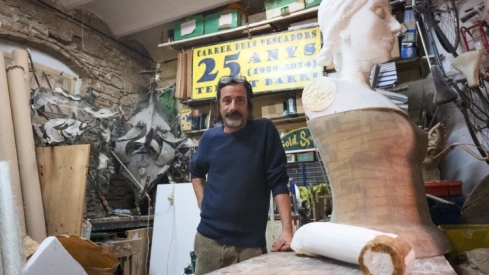
The health of a neighborhood is measured by the affection for its popular figures. At least, this is the view of David García, promoter of the artisanal workshop Constructors de Fantasies, located in the heart of Barceloneta. The project, started in 1997, specializes in the construction of the popular imaginary of different neighborhoods of Barcelona through giants, dwarfs and figurines, as well as materials for shows, parties, theater companies and television programs. Among his works, the figurehead for the entity Dones amb Sal stands out, the first gypsy giantess of the city commissioned by the Associació Gitana de la Barceloneta and, even, the famous and controversial Negre de la Riba of the same neighborhood.
The essence of the initiative lies in giving life to all the beasts, figures and characters that are part of the local stories of the neighborhoods and their neighbors. According to García, they are an essential part of the collective memory and transcend in time beyond their creators. “They embody the memories and identity of the neighborhood, and when I leave these works will continue to give battle,” affirms the artisan.
Son of the local world
García first came into contact with craftsmanship at Fira Creatures, a special effects workshop located in the heart of Gràcia. For years he learned the intricacies of manufacturing puppets, animatronics, costumes, sculptures and accessories, but he soon realized that the pace was “too stressful” and that the lack of work-life balance affected his private life. “It was a world that was too big for me, and I wanted to work on other topics, like popular stories,” he recounts. That is why he created the Constructors de Fantasies project together with his partner, Òscar Pérez, and rented a workshop in Barceloneta to delve into the characters, legends and Catalan folklore.
His passion for the local world does not arise from nothing. Son of Emília Llorca, neighborhood activist of Barceloneta and co-founder of the festival committee of Carrer dels Pescadors, the artisan grew up in an environment where the Festa Major and local culture were paramount concerns. “I have absorbed popular life since I was very young, and the festival committee has also been an important part of my life,” he says. In fact, the link between these worlds is so close that since he rented the premises, it is also used as a meeting point to organize the festivities.
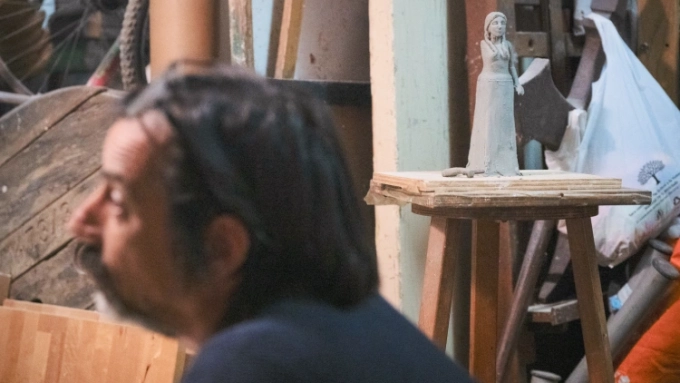
However, García started by making small artisanal pieces of Barcelona's historical bestiary, as well as puppets that he himself used to perform shows in schools, entities, or on the street. In 2000, shortly after starting the project, he made the leap to larger works, when the Barceloneta merchants' association commissioned him the big-head of Paco López Tey, a neighborhood resident who dedicated a large part of his life to collecting photographs of the neighborhood's past. “They were the first to trust me, and from there I launched into other projects,” he remarks.
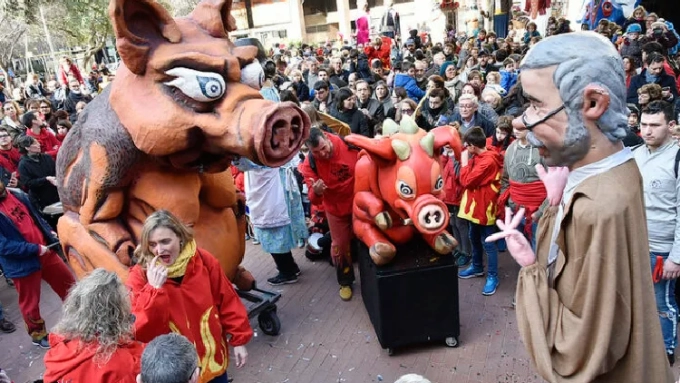
Since then, García has worked mainly for the neighborhoods of Sant Andreu and Barceloneta. He has made figures as popular in the city as l’Espurna –a fire beast– or the dwarf Manolito –a resident of the area around Sant Just square–, as well as the three big-heads Joan Isard, Planella, and Sampietro, from Sant Antoni, among others.
Resignifying neighborhood symbols
Besides the big-heads, giants, and popular beasts, García has also committed to the recovery of neighborhood symbols. In the case of Barceloneta, for example, in 2003 he restored the original figurehead known as the Negre de la Riba –blackened and very deteriorated due to a fire– commissioned by the Maritime Museum of Barcelona. The work, besides being installed on Andrea Dòria street, also became the emblem and image of the neighborhood.
According to the artisan, at that time the figurehead was an ideal opportunity to recover the maritime memory of the neighborhood, as the first time it appeared in the city was on an 18th-century vessel that docked in Barceloneta. Furthermore, in ancient times the figurehead became so popular that it turned into a new Bogeyman to scare children, and even playwrights like Serafí Pitarra mentioned it in their theatrical works. “Not even the elderly remembered the Negre de la Riba, and that's why, through the figurehead, we believed we could recover Barceloneta's maritime past, especially at a time when practically nothing was left of that part of history,” he explains.
Over time, however, the racist and colonial background of the Negre de la Riba was put on the table. In 2024, following the exhibition El Negre de la Riba and other myths to scare children, both the neighborhood and García learned that the mascaron represented a Native American made from the perspective of the colonists. Later, once his face was burned and disfigured, the stereotype of the “savage black man” and the “creature-scaring monster” was reinforced, which, according to García, reproduced –and continues to reproduce– racist imaginaries.
Now, this artisan and the neighborhood entities are trying to re-signify the mascaron without losing its essence. It is not an easy task, however, because it is a character that the neighborhood and the youth “have already made their own”. “We wanted to recover it, but not with these connotations, and now it is very frustrating because it is already part of the neighborhood's tradition,” he reflects. In this sense, they are currently in the process of reimagining this figure together with anti-racist collectives. “For now, the origin continues to be colonial, but he does not want to be so and tries to rebel,” argues the artisan, adding that they are looking for a formula for it to become an image that “racialized people also love”.
Is Barceloneta ending?
Finally, and if, as García assures, the health of a neighborhood can be seen in the care of its popular figures, how is Barceloneta's? “Screwed”, he answers. “Before, the festivities lasted a whole week and now, since they bother, they only let us do four days,” he adds. According to him, this implies a significant loss of neighborhood muscle, which weakens in the face of the threats the neighborhood suffers, such as the increase in rental prices, tourist pressure, or gentrification. “Before we were 30 streets celebrating Festa Major and now we are three. The commission was also a central engine and is increasingly losing strength. We are losing the choral groups… Things are changing, but we will see where to,” he concludes.


