
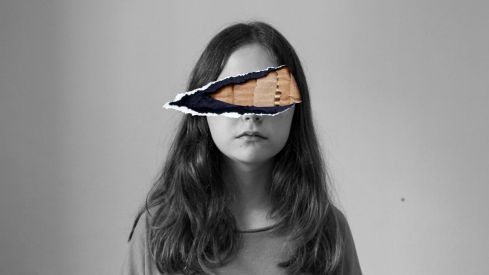
Learning to look and to look at oneself consciously is never an easy task, and in adolescence it is even less so. In this vital moment, identity is built in a fragile, changing and often contradictory way. And even more so in the current era, marked by immediacy, social networks and massive and ephemeral imagery.
La imatge que falta, an exhibition that can be seen at Casa Elizalde until May 9, starts precisely from this fragility to turn it into material for artistic and pedagogical work. The exhibition is born from a co-creation process with a group of twelve-year-old youngsters from the Escola Santa Anna of Barcelona.
The project has been developed as a collective creation laboratory driven by Carlota Polo, primary, secondary, and university teacher; Mireia Pujol, filmmaker and film director; and Arola Valls, researcher in the relationship between photography, contemporary art and education, and professor at the University of Barcelona.
All three, linked around the Santa Anna School, decided to push forward the project from their experience in the fields of education, cinema, and artistic research.
Beyond production
“The proposal does not start from teaching to produce images, but from learning to look in another way”, says Arola Valls, one of the curators of the exhibition at AMIC Cultura, who adds that the fact that we are so surrounded by images ends up causing important vital experiences to precisely remain unportrayed. This tension between visual excess and lack of significant images is from where they began to work.
For ten weeks, nine adolescents dealt with the deceleration of the gaze. “We worked a lot from slowness; the idea was to understand that an image is not just a result, but a decision full of layers,” explains Valls.
In this sense, it was proposed to the participants to deactivate the automatisms of the gaze, to learn to observe what usually goes unnoticed and to understand the image as a symbolic construction, beyond its final result.
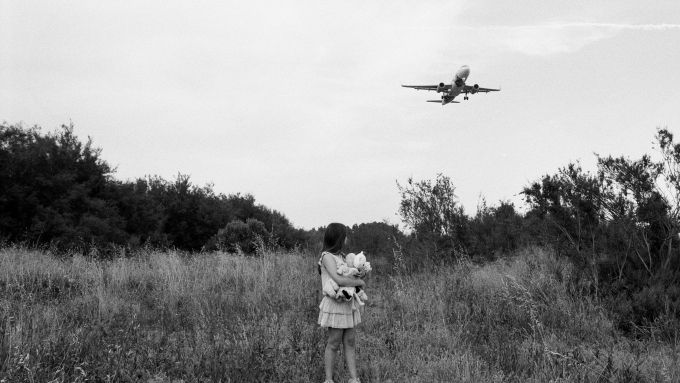
The search for the “absent image”
The central exercise of the workshop, however, was the search for an absent image: the young people had to think of a personal experience, like a conversation that did not take place, an interrupted moment or an emotion difficult to place and translate it into a non-literal image.
“When we want to cross something, we must be able to name it and put an image to it; this helps us to elaborate it,” points out Valls. This gesture of visualizing what cannot be seen literally becomes a tool for thought and emotional work that they have wanted to use in their favor.
The result of all this are photographs that do not literally tell a story, but rather open multiple layers of reading. And this makes this experience, apparently scholastic, attractive to the public of Casa Elizalde. “What we find are portraits with many layers; as spectators, perhaps we don't get to the detail of what happens to them, but they do serve as a mirror for us”, explains Valls.
Less images, more awareness
In this sense, the project also questions the contemporary saturation of visual production. “We did not want to contribute to making more images that say nothing,” states the co-curator. For this reason, the idea of economy of images was insisted upon: less production and more awareness, while working the patience of the analog world.
With all that, they have been able to generate a whole real space of listening that has had a great impact in all their school environment, and that they are already studying to be able to extrapolate also to other collectives, such as that of the elderly.
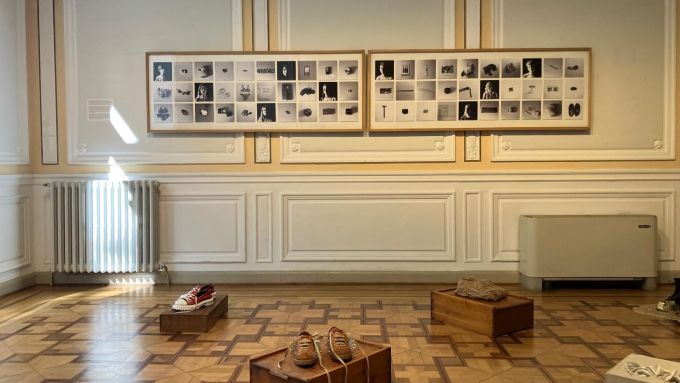
Another way to work with young people
The final result of the project is an exhibition of nine portraits made by the nine participants. In addition, a series of objects that have been part of this whole process are also exhibited: field notebooks, conversations, preliminary exercises and reflections on the objects and spaces we inhabit.
With this art exhibition, finally, it is intended to assert a way of working with young people that neither infantilizes nor simplifies their experiences. “They are not children making art, but working with artistic languages,” Valls emphasizes.
And upon finishing seeing the show, a question that turns the exhibition into an experience of projection and return, where looking at the other also implies looking at oneself. And you, what image are you missing?


