
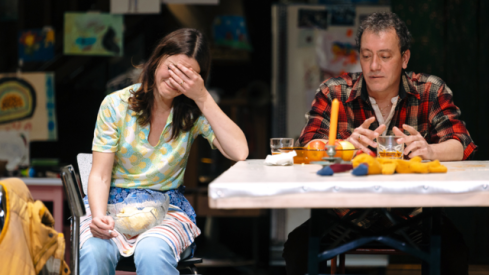
Julio Manrique doesn't do things by halves. El barquer, which is now premiering at the Sala Fabià Puigserver of the Teatre Lliure de Montjuïc, is a complex production, with nineteen characters on stage, which requires a company of 21 actors because there are four underage actresses who have to perform alternate functions. It is, moreover, an intergenerational play, which requires actors of ages ranging from eighty to seven years old. We are faced with a choral work, like those that in this country are usually only done by amateur theatre and which require the involvement of an entire town, be it the Pastorets or la Passió.
Saving the distances, El barquer is the story of a passion. The Carney family has lived for ten years with the uncertainty of the disappearance of Seamus Carney, a member of the Irish Republican Army, the IRA. Everything suggests that Seamus has been 'sacrificed' by his own comrades to have informed the English.
El barquer is a work about a family grief intervened by political rage. From the first scene we already know that the body of Seamus Carney has been located at the bottom of a swamp with a shot in the head, but his ghost has been dragging itself for ten years and has shaped the lives of the Carneys for all this time
At the center of this peasant family is Quinn Carney (Roger Casamajor), a forty-year-old man who has decided to build a family in a protected environment, a rural house in County Armagh, on the sidelines of the political conflict. His wife, Mary (Marta Marco), has given him seven children and the youngest is nine months old in the summer of 1981. He is called Bobby, like Bobby Sands, the first IRA political prisoner to die as a result of a hunger strike in prison in May 1981. Quinn and Mary have taken in Caitlin (Mima Riera), Seamus's wife, and her son, Oisin Carney, a tormented adolescent by his father's disappearance
El barquer takes place over a single day in August 1981 and places us in a crucial historical and political context for Northern Ireland, at an important moment within the period known as the Troubles, a conflict that pitted Irish Catholic republicans against Protestant unionists and lasted for thirty years. The Ulster conflict left thousands dead and also many open wounds, as journalist Patrick Radden Keefe has explained very well in No diguis res (Periscopi), a book that has been required reading for the actors of El barquer.
“Quinn Carney had been part of the IRA, but at one point he decides to exchange armed struggle for the Irish homeland, all for the preservation of the peace of another homeland: his family. He tries to keep his tribe away from violence but, inevitably, violence will end up knocking on the Carney’s door,” says Manrique.
About Seamus's disappearance the suspicion hangs that he was a traitor. Quinn, without being a deserter, is someone who has also abandoned the cause and sooner or later must pay a price for his withdrawal in a country where half-measures are not admitted.
“Jez Butterworth is an author capable of writing up to 19 characters and managing that they all have a soul, their own voice, and that they are all relevant,” says Julio Manrique. “There are no extras, they are all essential pieces within the narrative”.
Esteve Gorina, assistant director, points out that El barquer is a work in which each actor, whatever they say, has someone to look at or respond to, people living life on stage”.
Manrique also values that “Butterworth explains the story through the characters. He doesn't seem interested in raising his voice above those of the characters to moralize, to reach any closed conclusion, or to give us any kind of lesson,” states the director
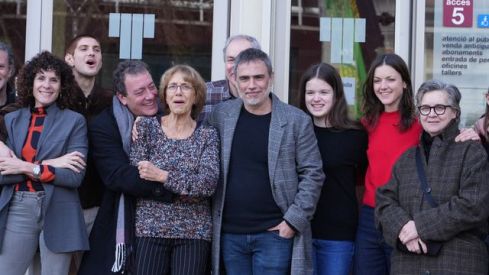
El barquer tells us the story of an accordion family, which has a Chekhovian air, because it gathers in a single house members of different generations of the Carney and other superimposed people who are staying there, permanently or visiting. The Carney are like the accordion, an instrument that expands and contracts with a groan that can be both festive and painful.
Quinn and Mary live in a farmhouse in Ormagh with their seven children (played by Oriol Cervera, Martí Gordero, Lua Amat, Sara Roch, and the duets formed by Nora Pàmies/Elena Salvat and Bruna Luz and Bruna Armengol. They also live in the same house with three very idiosyncratic elderly people: Aunt Maggie (Anna Güell), Aunt Pat (Imma Colomer), and Uncle Pat (Carles Martínez), all three single, who each represent a different way of confronting the abnormality of a politically dismembered country. Maggie, at eighty years old, is a visionary woman, capable of perceiving invisible things, and the conversations of the seven Carney children with her are funny and delirious, because deep down Maggie has taken refuge in a world of fantasy. Uncle Pat, seventy years old, is an observant old cat, who connects the family with an atavistic tradition that goes back to time immemorial. And finally, Aunt Pat is a woman who lived through the independence of Ireland firsthand and who carries an emotional wound for decades. She embodies like no one else the political rage that will later erupt
As if that were not enough, the Carney family also has an Englishman in their home, Tom Kettle (Norbert Martínez), who has lived for years tolerated by the family within this Chekhovian amalgam.
The British Jez Butterworth wrote this story with firsthand information, as his partner, the Irish actress Laura Donnelly, experienced a similar case within her family. Her own uncle was a member of the Irish Republican Army and was one of the 17 IRA fighters purged from within their own ranks.
Butterworth places the discovery of the corpse just the day before harvest day, an annual celebration in which the Carneys always receive the visit and help of the Corcorans, three wild adolescent youths who bring dangerous airs from the city. They are Diarmaid (Jan Serra), Declan (Max Vilarassa) and the cocky Shane (Marc Soler), who is also involved in armed struggle and will open the eyes of the Carney's older sons. The Corcorans would be that kind of cousins that you only see once a year but who know your most rotten secret and rub your wound.
The Carneys will receive other uncomfortable visits. That of Father Horrigan (Santi Ricart), the family priest, who plays a murky role as a mediator with the IRA, and the ominous visit of an IRA emissary, Muldoon (Ernest Villegas), who presents an inadmissible proposal to the Carney family. Everyone knows what happened to Seamus, but the time has come to decide how his death should be explained to the world. Quinn's struggle to control the narrative of his brother will entail a sacrifice for the entire family
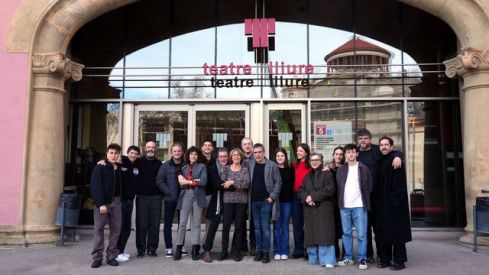
A great theatrical family
Manrique is very satisfied with the rehearsal process of the play. "An extraordinary family has been generated naturally, out of generosity. We did not want, from the beginning, to fall into customariness," adds Manrique. "And, at the same time, we did not want to betray a piece that moved us deeply with a conceptual proposal that would override it," says Manrique.
Roger Casamajor has highlighted that Manrique has given them freedom but at the same time is very demanding. “We have been focused on this for weeks and we are eager to show the public all this work”.
At her eighty years, Imma Colomer is the oldest actress in the cast and is happy to participate in this intergenerational play. Colomer finds many resonances between the action of The Boatman and things that have happened in Catalonia in recent years. "Things that have been hard for us to let go of. Hate exists, and it's hard to get rid of it when you've suffered so much."
Carles Martínez says that hate is a passion that if one does not stop, it never ends. And if someone gives in, they receive a great punishment from their own. The loser lives with a very great latent hate"
Norbert Martínez defends that complex and intergenerational works like this one are carried out and the value it brings to the profession, because it facilitates the patrimonial transmission of a tradition and a craft from generation to generation”.
Carles Pedragosa has taken charge of the musical direction and soundscape. The work begins with a sublime song performed by Sara Roch. All the songs in the work are sung in Gaelic and belong to a series of pieces called Laments, which, like Portuguese fado, have the strength to purify pain with simple but emotion-filled melodies


