
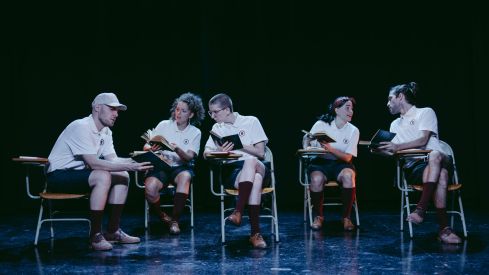
“Tap dance is still associated with old musical cinema, with Fred Astaire and Ginger Rogers and, instead, it is much closer to a rhythmic show. But for programmers to know it, they have to see it, and they don't come”. These words are from Clara Martínez, dancer and teacher at Luthier, one of the reference tap dance schools in Barcelona. Martínez's complaint is shared by other dancers in the city who, despite having shared spaces with numerous international students for many years, struggle to make the discipline known and find a place in Barcelona's cultural programming.
“I have reserved tickets for programmers countless times and they have not appeared. How can we show them what we do? I don't know if they don't trust it or if they are not interested,” laments Martínez, who recently launched a jazz quintet where tap dance is “one more instrument.” So far they have performed in a restaurant in Born, but now they have set out to access professional jazz circuits. “We found the first opportunity at a very well-known festival in Frankfurt and this summer we are performing in Belgium.”
According to this dancer, the lack of knowledge of tap dance is the main Achilles' Heel for companies to emerge in Barcelona's programming. All in all, in a city that the sources of this report cite as “the tap dance capital of Europe” and which is on the verge of celebrating International Tap Dance Day, this Monday, May 25.
Barcelona, tap dance capital of Europe?
Guillem Alonso is, since 2011, the director of the Luthier school, located in the Dreta de l’Eixample of Barcelona. Alonso, furthermore, is a dancer of the prestigious tap dance company Camut Band, founded in 1994, with a long trajectory of its own shows that have been performed in the city, in the State and worldwide. Alonso's experience leads him to affirm that, beyond the United States, the mother country of the genre, if we talk about Europe, Barcelona is the capital of tap dance. One of the indispensable pillars is, as he explains, the schools that have been committed to it for decades, such as El Timbal, Coco Comín, Elisenda Tarragó or Memory. The peculiarity of Luthier is that, like the other mentioned centers, theater or dance classes are held there, but it has a much greater offer of tap dance.
And why does Luthier attract so many foreign dancers? “There are German students, for example, who tell us that in their cities there is only one tap dance teacher. Here there are classes 24 hours a day with fifteen teachers, in addition to a strong community and many shows to go see. There is no other place where they can find it,” comments Martínez from one of Luthier's classrooms, where she teaches classes. This internationality, in fact, she experiences firsthand with her other company, La Banda Street Groove, where they mix tap dance with urban dance and body percussion and which is formed by five Catalans, one Frenchman, one Italian, and one Colombian established in Barcelona who came attracted by Luthier's professional training.
A strong local community, but opportunities outside
Martínez introduces the concept ‘community’, one of the key points that interviewees highlight, despite the difficulties, to continue at the forefront in a city often hostile to tap dance. “There is a lot of familiarity. I have never felt that I had to compete with anyone, a fact that perhaps happens in other artistic sectors,” values the dancer.
This word also gains strength in a recent publication by the dancer and researcher Gisela Noguero. In El claqué a Barcelona: la història d’una comunitat (El Punt Volat), the artist explains how tap dance consolidated in the city starting in the eighties with key figures such as the Méndez brothers, Mireia Font, Toni Mira, and later, with the aforementioned Guillem Alonso and Clara Martínez.
The golden age of tap dance is situated between the nineties and 2010
The book gathers an idea that Alonso supports: the golden age of tap dance is situated between the nineties and 2010, when the community was very strong and there was a lot of work. “The Camut Band did many tours, we didn't stop working,” he states. But the 2008 crisis affected the cultural programming of the city councils, indispensable for the sector. “They told us we would get paid after a year and a half,” recalls the dancer, who adds that he recovered thanks to his incorporation into the Luthier school. Since then, the sector breathed again, although the coronavirus crisis impacted again.
Who has also juggled to find work is Martínez with La Banda Street Groove, born from a residency at the Centre Cívic Barceloneta, a municipal facility specialized in dance. Despite having been part of the programming of various civic centers, of the Barcelona Districte Cultural program, La Mercè or Dansa Metropolitana, the dancer details that “opportunities come in drips” and that, in general, they are recognized “more outside of home than here”, where it seems that tap dancing “is not enough, but often has to be masked as family theater, for example”. Specifically, Martínez details that with this company they have been trying to access the school dance circuit for three years and that “there is no way”.

Programming tap dance: lack of knowledge and pigeonholing
Until now we have talked about the problem of lack of knowledge regarding tap dance, but the consulted sources add a second drawback, pigeonholing. “Before, art in general was programmed and now there is more demand. Programmers have wanted to specialize. Before, you would do a show that combined circus, tap dance, and comedy and it was more welcome,” comments Alonso. For her part, the author of Tap Dance in Barcelona: the history of a community adds that the “grace of tap dance is that it has many facets”. In general, shows dance between two waters, as they mix dance and music. “Since everything is compartmentalized, sometimes we are considered dance shows, a circuit that is difficult to enter. If dance is already invisible, where does tap dance stand?”, laments Noguero.
In this sense, the interviewees denounce that the non-existence of a labor agreement for the dance sector means that sometimes theaters or venues do “whatever they want” with them. Noguero currently works as a dancer for the company Teatre al detall, which facilitates conditions, as the theater does have a labor agreement.
"If dance is already invisible, where does tap dance stand?", says Noguero
In the case of dance in Catalonia, only the Pacte Laboral is available, which was promoted in 2005 by the Association of Dance Professionals of Catalonia (APdC) and affects affiliated companies and professionals linked to the association, but not the entire sector. Cèsar Compte, manager of the APdC, explains that right now the entity is working with the Association of Professional Dance Companies of Catalonia to “equate the agreement with a convention” with new measures that, among others, foresee “adjusting the prices of shows, rehearsals, recognizing sick leave”. It is expected to be launched this summer.
Despite these updates, Compte is clear that the underlying problem is another: “The lack of a labor agreement does not prevent more or fewer tap dancer hirings, it is about the lack of knowledge that exists about dance. From the APdC we do important work so that dance appears in programming”.
“We cannot stop dancing”
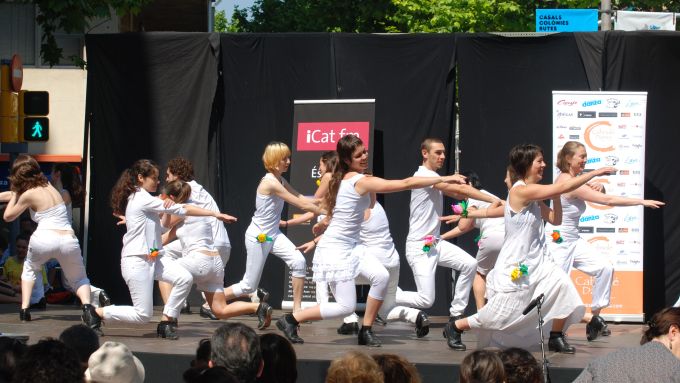
“One of the conclusions I have drawn from the book is that, despite the difficulties, we continue to chip away at it. We cannot stop dancing,” Noguera states. She, precisely, is a member of Tot pel claqué. Created by Guillem Alonso, Mireia Font and Maribel Pascual 27 years ago, it is the only association in Spain dedicated to the dissemination of the genre and, in fact, around International Tap Dance Day, they organize various activities. To begin, next Monday they invite to enjoy a documentary dedicated to Gregory Hines and led by Ruben ‘Fruty’ Pérez at Occulta del Raval at 7 p.m. Afterwards they will present the Premi Claqueta 2026 to the dancer and teacher of Escola Luthier, Roser Font. Next May 30 they will continue the celebration with the Gala of emerging creations at Centre Cívic Casa Groga starting at 12 p.m. and on the 31st they celebrate in Sants the 22nd edition of Claqué al carrer, a festival dedicated to the genre organized annually by Tot pel claqué.
Besides, the search for prestige in Barcelona also goes through a scene that, far from the main spotlights, keeps the genre in movement through small companies, alternative spaces and open gatherings. One of the Barcelona reference points is the Teatre Golem’S in Gràcia, where on the last Sunday of each month live music and tap dance sessions directed by Laia Molins are held that gather artists and regular audience of the circuit. To this is added the gathering that takes place on the first and third Sunday of each month in the Ciutadella park, a free and open space where dancers improvise outdoors, often accompanied by live musicians.
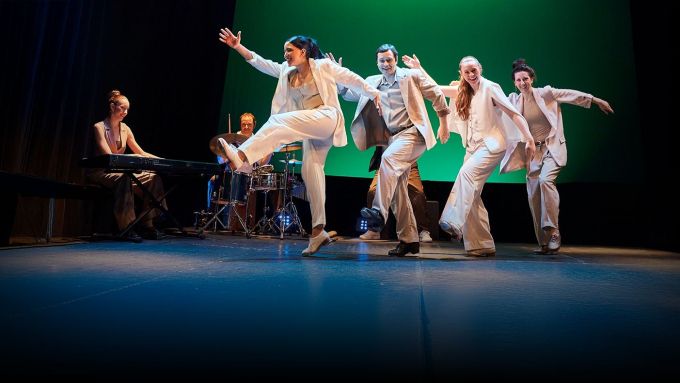
In this ecosystem also stand out, among others, Barcelona companies like Cotton Bros; The Hot Shoe Sugars, a company formed by two Englishwomen (Dominique Cresswell and Brooklyn Barber) and one Frenchwoman (Marie Wils) who arrived in Barcelona to study the professional training of Luthier and have ended up settling there; La Banda Street Groove and the company of Clara Martínez who will perform on June 19 within the Ritme cycle at the Can Felipa Civic Center. To this constant activity are added proposals such as the show Set de ritme, by the veteran Camut Band, which these days tours the Catalan territory.
Barcelona, therefore, has become a European refuge for tap dance: a city with specialized schools, a consolidated international community and a scene that has not stopped creating despite precariousness and invisibilization. But the contrast is evident: while students arrive from all over the world to train here, local companies continue to encounter the lack of programming, institutional ignorance and the pigeonholing of a genre that many associate with clichés of the past. Despite this, the tap dance community continues to chip away from civic centers, small theaters and public spaces with the conviction that, sooner or later, Barcelona will end up recognizing what the rest of Europe has been seeing for years.


