Ànima is a musical that can be seen until May 24 at Teatre Tívoli. It is a story of tenacity: despite the drawers where the project slept for several years, despite the production companies that looked the other way, despite a sector –hey, it's not the only one!– that doesn't always know how to recognize what it has in front of it. Ànima is, a perfect mirror of this irreducible tenacity that allows a passion to be turned into a reality. Before winning the competition that allowed its premiere at the Teatre Nacional de Catalunya, the project received rejections, endured the weight of doubt, reformulated itself and survived discouragement. A trajectory that, without being sought, turns the musical into a declaration of principles: the story it tells —that of a girl, Greta, who wants to be an animator in a world not designed for her— is, also, the story of how the production was born. At Núvol we have already talked about the musical, and I will not elaborate, beyond saying that it is a work that is really worthwhile, and the libretto and songs function like a perfectly executed gear by a cast in a state of grace.
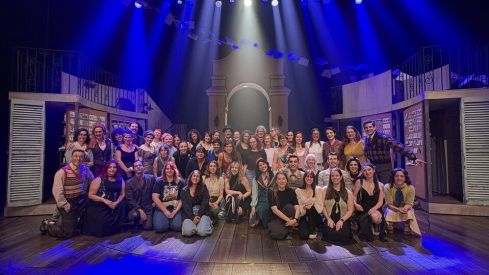
But on April 29, on the occasion of International Design Day, the performance that the company Vero Vero offered at the Teatre Tívoli invited thirty-five female illustrators. If, as they sing in one of the musical's pieces, "every star is a dream that someone has managed to make real," at the theater there were thirty-five stars, thirty-five real stories –which could have been many more– parallel to the one unfolding on stage. Thirty-five dreams full of illusion, persistence, talent, disappointments and, above all, tenacity. Because although, to draw, "a pencil is enough," to professionally survive in this difficult world, perhaps something a little more is needed.
The artists gradually arrived, passed by the box office to collect the invitations and camouflaged themselves among the public with a naturalness that didn't deceive anyone who knows how to look. Red hair, buns held with a pencil —the tool, the emblem, the prolongation of thought—, sparkling gazes. Veteran authors, hardened in a thousand battles, and other young ones, just out of the egg, met again far from the drawing table and talked, as those who have converted their passion into their work or vice versa always talk, about the latest book published, about the new project boiling in the studio, about the ideas that have not yet found form. Laughter, kisses, hugs, jokes. Queue to pee. Several generations sharing the same space, the same slightly nervous enthusiasm of one who knows that that night will be special without really knowing why. Popcorn.
The performance unfolded with the display of passion that the company Vero Vero has managed to imprint on this more dynamic and reduced version of the show. From their seats, the illustrators followed Greta's story with that particular attention given by someone who not only sees a fiction but recognizes a journey. Some nodded slightly at certain scenes, with their head tilted a few millimeters, the involuntary gesture of someone confirming what they already know. More than one tear. Goosebumps in the face of an identification that was not sentimental, but structural: what was happening on stage had happened, in one way or another, to many of those sitting in the stalls. In the end, with the audience standing and applauding, Paula Malia asked for silence in the hall to announce the presence of the illustrators. The Tívoli resumed an ovation that made the walls tremble. People from the pencil guild, who are mostly solitary, taciturn, agoraphobic, handle crowds very poorly. And even worse if we somehow become the center of attention. While the palms echoed in the theater, some glanced sideways at the location of the emergency exits. Others calculated if they could hide under the seat. Hardly any other performance of Ànima could achieve a more direct connection with the stalls than with the audience that night where there were so many authors and partners, parents and friends, people who have lived, suffered, and encouraged artistic careers unfortunately too similar to what had just been seen under the red damask of the Tívoli. Afterwards, the artists went up to the stage. The group photograph with the cast taken at the end is a clear and resounding image: thirty-five ways to persist.
It is not, however, a question of figures. The incorporation of women into the world of illustration, animation, and comics has often been narrated in terms of conquest –as if it were about invading an alien territory– when in reality it is about a simple normalization of what should never have been otherwise. No field should be the exclusive patrimony of a single gender, and even less so in the artistic one, where the diversity of perspectives is the condition of possibility for any richness. However, what needs to be emphasized here is that the true transformation has not been the female integration into pre-existing structures. It is not enough for women to do the same work that men did before, serving the same ideas, within the same formats. The revolution –and the word is not excessive– has arrived when female illustrators have been able to carry out their own projects: when they have put their talent at the disposal of their own perspective, not that of others. From this, new themes, new sensibilities, new ways of constructing a narrative through image have emerged. A visual territory that did not exist because no one had traced it. This is the future we want, where the talent of our artists enriches us, perfects us, and makes us better. We hope to have completely left behind the time when a female artistic career always remained in the shadow of her male partner, as happened to Montserrat Barta (1906-1988) or Antònia Trenchs (1913-1939), or when the talent of artists was used to perpetuate structural sexism, as happened to Trini Tnturé (1935-2024), Purita Campos (1937-2019), or Carme Barbarà (1933). It is worth reading Marika Vila, who has studied and explained very well how drawing, under the male gaze, has been used as a tool for political and social construction.
In that photograph with the cast of Ànima most of you will see a flock of laughing girls. But behind each smile there is a struggle, a story, a star that shines with the light of an accomplished dream. Above all it is the photograph of a constellation of talent. Because on the stage of the Tívoli, what sparkles is the dreamlike tenderness of Mercè Tous, the atmospheric chromatism of Anna Valpuesta, the watercolor instrospection of Marta Casals, the naive tenderness of Marta Palet, the expressive vigor of Júlia Olivella, the joyous vitalism of Mónica Roca, the plastic introspection of Teresa Calbó Angrill, the ethereal femininity of Tania Luque, the playful lightness of Elena Pedrola, the colorful warmth of Miriam Fernandez Diaz, the delicious detailism of Sara Sánchez, the ironic forcefulness of Lyona (Lyona Ivanova), the evocative subtlety of Marta Rovira, the austere elegance of Laura Varela, the precious ductility of Aina Pongiluppi, the lyrical strength of Natalia Balza, the emotional vibration of Alba Martí, the ethereal expressionism of Montse Fortino, the expressive sensiviliaty of Glàfira Smith (Andrea Ferrando), the exuberant eroticism of Rainvart (Rocío Vidal), the Mediterranean light of Sílvia Pons, the experimental versatility of Alba Domingo, the poetic forcefulness of Maria Beitia, the plastic fluidity of Eider Santos, the graphic meticulousness of Laura Reixach, the childlike affability of Maria Josep Subirachs, the graphic audacity of Maria Losada, the fascinating expressiveness of Eva Sánchez, the sharpened craft of Anna Mongay, the lyrical filigrees of Elena Val, the bustling experimentation of Rosa Vidal, the brilliant spontaneity of Mercè Galí, the nascent courage of Aina Vegas and the uninhibited joviality of Chuchu (Sónia González). I don't know if I can imagine the possibility of living in a world capable of letting all this talent escape. But Catalonia is today one of the main European creative hubs in the field of visual arts and it is so, not thanks to industry nor institutions, but, precisely, because of the stubbornness of the authors to follow the path dictated by the depths of their soul.
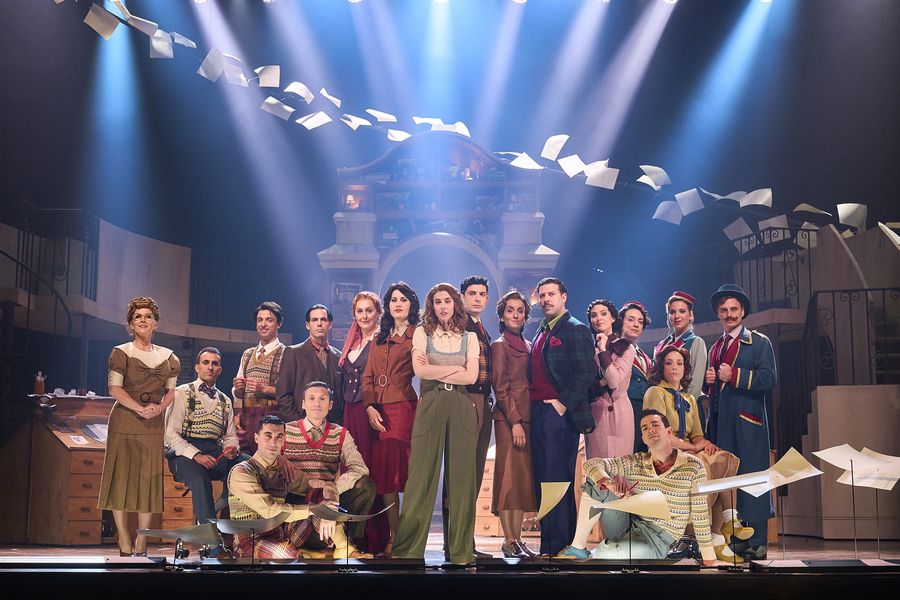
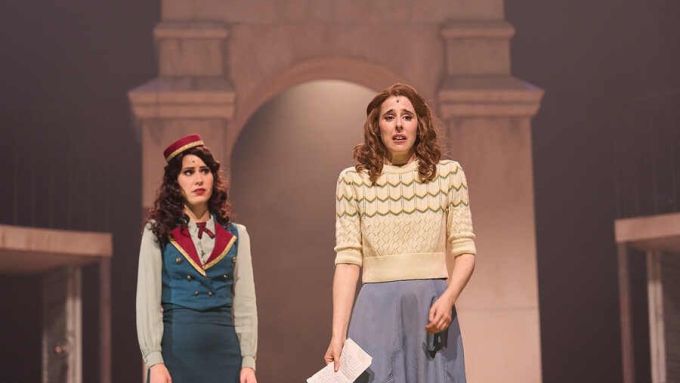
We celebrate the existence of Ànima –little remains, they lower the curtain soon, go!– of its celebration of talent, of its will to inspire those who come behind. The staging is delicious, the songs are catchy, the actors embroider an interpretative filigree, but above all, Ànima is, in this sense, a precise example of what we have been describing. Not only a good idea by Oriol Burés about a girl who wants to fulfill her dream in a world of men is, also, a product created from a perspective that knows what it's talking about because it has lived it. And the evening that thirty-five illustrators —with all the differences in trajectory, age, style that separate them, with all the similarities: experiences, illusions, fears, contempts that unite them— went up together on that stage was not only a symbolic gesture, but the demonstration, in flesh and in pencil, that collective persistence is the only effective response to an industry that, too often, continues to pretend there is nothing to see.


