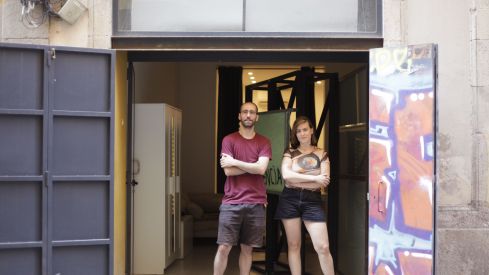
Days ago, in Barcelona's Raval, an exhibition could be seen in an illegal tourist apartment that denounced the housing crisis. It was the project Tot podria ser diferent, by artist and cultural mediator Iris Verge and history researcher Miquel Hernández. The exhibition was only displayed for 48 hours, specifically on Sunday, June 28, and Monday, June 29. These days, however, and until July 30, it can also be seen for free at the Centre Cívic Casa Orlandai, in Sarrià-Sant Gervasi.
It all started last September, when Verge and Hernández received the Sant Andreu Contemporani award, a public program in this Barcelona district dedicated to contemporary art that annually awards the Miquel Casablancas Visual Arts Prize. Tot podria ser diferent was the winning project in the mediation category.
How do you make an exhibition in an illegal tourist apartment?
After months of work, the project leaders made a first presentation with an installation in Plaça d'Orfila in Sant Andreu on May 23. Later, the exhibition was also at the Centre Cívic Sant Andreu for a month. "Besides, we wanted to do an exhibition more in tune with the project. We wanted to show that no matter how much they say there's zero tolerance for tourist apartments, we've been able to choose from many. The law is made, the loophole is made," says the cultural mediator.
Thus, Verge and Hernández rented a 50-square-meter ground-floor apartment that was rented for more than 200 euros a night. Through the installation panels, the public who accessed it learned that, despite the regulations, in Barcelona there are almost 4,000 apartments that, according to the exhibition, operate without a license.
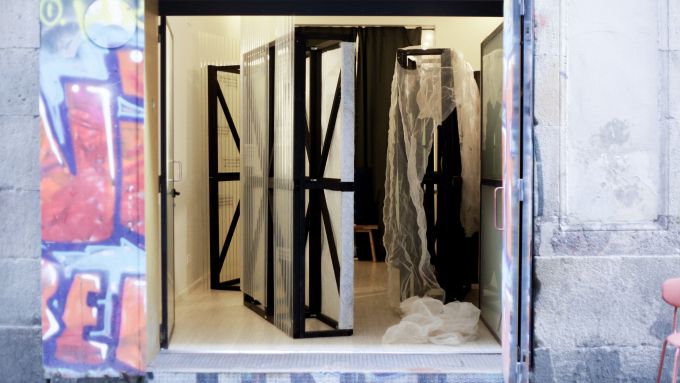
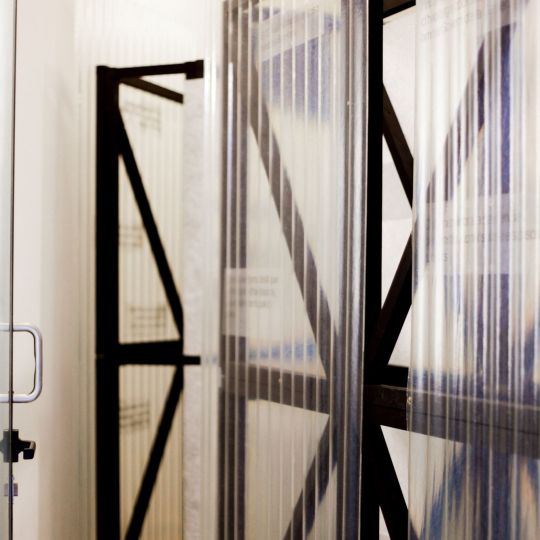
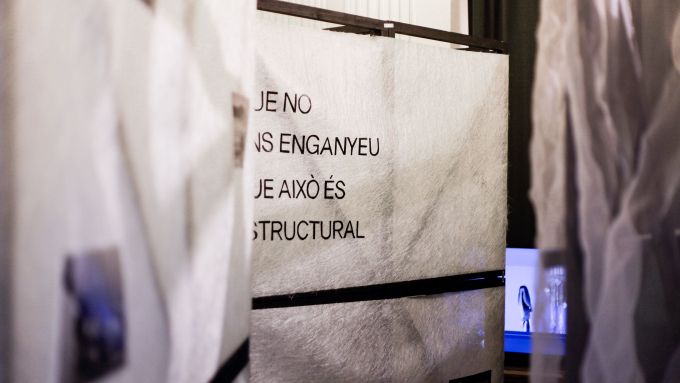
The exhibition was conceived in the Arts Can Batlló warehouse, in the Sants neighborhood, where Hernández and Verge made the final piece from construction materials. Some of them are translucent, because they wanted to refer to "apparent reality," as Verge points out. "Policies are being made to curb tourist apartments and, if we look at the headlines, it seems that by 2028 it will be resolved, but it won't," this cultural mediator denounces. On the other hand, the exhibition includes wooden bars where the following phrase can be read: "Don't fool us, this is structural."
Why was the apartment illegal? Iris and Hernández, as they recount, searched the Generalitat's housing registry for the license number of this apartment offered on Airbnb and found that it was not registered. In addition, the Barcelona City Council has a search engine to see registered apartments in Barcelona, and this one was located in Sants, not in Raval.
However, the artists have received legal advice during the process. They were advised that to "cover themselves from any possible problem" they should use an invitation system, so that all those interested in entering the exhibition had to be part of a Telegram group where the time and place of the appointment were announced one day before.
Denunciation through art
The exhibition was conceived many months ago, but it began its first steps last October, when the cultural mediator and the history researcher held a first meeting at the Sant Andreu Civic Center with the Sagrera Housing Union, with whom they carried out several "reflection dynamics to dismantle discourses against gentrification." They also met with people from the neighborhood affected by the housing crisis, as well as with the research group Memòria, lluita i resistència.
The creators of Tot podria ser diferent are happy with the result, as having come into contact with groups and individuals who "suffer the consequences of the housing crisis" differentiates them, they believe, from other projects framed within artistic mediation. "Often, visual arts practices related to territorial conflicts are carried out, but rarely does one move beyond the idea of an exhibition in the form of a white cube," they say.
Furthermore, they believe that art must have a commitment to society, an idea that, according to them, has been lost since the nineties, although for Verge there are still inspiring references like Leonidas Martín. Finally, the artistic mediator celebrates that, days after the exhibition in the tourist apartment, she learned that she has been awarded a scholarship to curate exhibitions at the Botín Foundation.