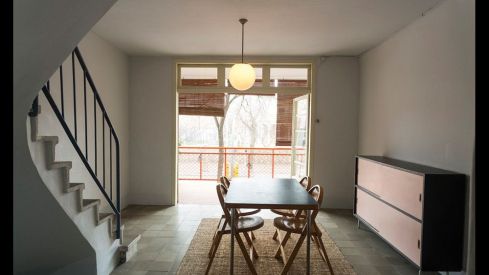
Photography can be understood as an artistic manifestation, but also as documentary. Rarely, however, is its vocation of service to the citizenry considered. Well, the Barcelona-based photographer, born in Madrid, Manolo Laguillo, encompasses all three, and he demonstrates this in his latest work Campo/contracampo, an artistic intervention carried out in one of Barcelona's most important and unknown heritage buildings of the 20th century: Casa Bloc.
Located in the Sant Andreu neighborhood, Casa Bloc is a block of social housing buildings promoted in 1931 by the Generalitat de Catalunya of the Second Republic, and was conceived by Josep Lluís Sert, Josep Torres Clavé, and Joan Baptista Subirana of the Grup d’Arquitectes i Tècnics Catalans per al Progrés de l’Arquitectura Contemporània (GATPAC). It is a complex of five interconnected S-shaped blocks with 207 homes ranging from 55 to 77 square meters intended for the working population, and it was launched amidst a large migratory wave where the lack of residential resources caused uncontrolled growth of shantytowns in the Catalan capital.
The Casa Bloc is also one of the first and only examples of rationalism in Catalonia when it began to proliferate throughout Europe in the interwar period. Originally, a ground floor was planned for community services such as nurseries, libraries, social clubs, and open spaces for sports, and although at the time it was one of the most innovative projects on an architectural and social scale, the Civil War halted its construction and, later, the Franco dictatorship eliminated the progressive and community essence of the building. In fact, from that moment on, the Casa Bloc began to deteriorate, and soldiers, war widows, orphans, and teachers eventually moved in. Furthermore, the original idea of the project was altered in 1948 when a sixth space known as the "ghost block" was built, intended for police officers and their families. When the building returned to the hands of the Generalitat in 2000, this block was demolished, the entire complex was restored, and one of the modules was turned into a museum.
Now Manolo Laguillo is putting the building back on the map through his photographs. He has done so as part of the second edition of the Generalitat de Catalunya's Passat/Present project, an initiative that invites the public to read and interpret Catalan heritage from the perspective of contemporary artists. Thus, as the project draws to a close, its protagonists are taking stock of the initiative.
Photography in the Service of Citizenship
"What I've tried to do, and I think I've succeeded, is to make the Casa Bloc and its history, what it has represented and represents, better understood through photography," assures the veteran and renowned photographer, who adds that the intervention has a "vocation of service to the citizenry."
Thus, their proposal consists of a photographic paper folded in an accordion shape known as a leporello, featuring a total of eight images that portray the building from different perspectives. The first two images aim to focus on the building's characteristic 'S' shape and its location within the city, while the rest take a tour inside the space until reaching street level.
In this regard, he explains that the photographs of the rooftop were not taken from the Casa Bloc, but from another building directly in front of it. "Besides the fact that it's forbidden to go up to the Casa Bloc's rooftop, the other problem was that it was too close to the building to photograph it well," the photographer emphasizes. "If I wanted its very particular shape to be appreciated, I had to position myself somewhere that had the Casa Bloc immediately above me," he details. Thus, while walking around the area and investigating the structure, Laguillo says he met the president of the residents' association of one of these buildings located opposite the Casa Bloc. "My luck was meeting this neighbor who let me go up to his rooftop, which is where I was able to take the photos that ended up in the leporello," he celebrates.
According to Laguillo, the images from the rooftop also reveal the trace the dictatorship left on the building. "There's a part of the facade that looks empty, as if it had a hole," he states, while clarifying that "it's precisely where it was built when the ghost block was expanded, which was demolished in 2008." However, the photographer assures that the building still bears "a scar" from this past, something he knew he "wanted to photograph for the project."
In this vein, the rest of the photographs highlight other unique parts of the building. For example, Laguillo insists that in the fold-out he has also captured the interior parts of the Casa Bloc from where the soldiers kept guard. "After the Civil War, one of the ground floors was also used as a military prison, and to control these dungeons, they made holes in the walls to monitor the space, another very particular feature that I have photographed," he remarks.
A Very Personal Look
Frederic Montornés, curator of the Past/Present project and art critic, was the one who personally selected Laguillo. According to Montornés, the great peculiarity of the Casa Bloc intervention is that the photographer manages to take "a tour of the interior of the building and not from the outside, containing in each of his images the entire life of those who live there." At the same time, however, the art critic insists that the photographer has done so "without capturing, in any case, a single human image, despite being frequented spaces." "His gaze is that of someone who has walked a lot through the space, who has gone up and down the stairs a thousand times, who has looked for very specific images and then selected them again to form part of a leporello," he points out.
Furthermore, the art critic insists that the project has managed to give the Casa Bloc "a mobile perspective" of the building. "Laguillo has not only portrayed concrete, glass, and rationalism, but the lived experience, history, and the building's experience from within," he emphasizes
From the periphery to the center
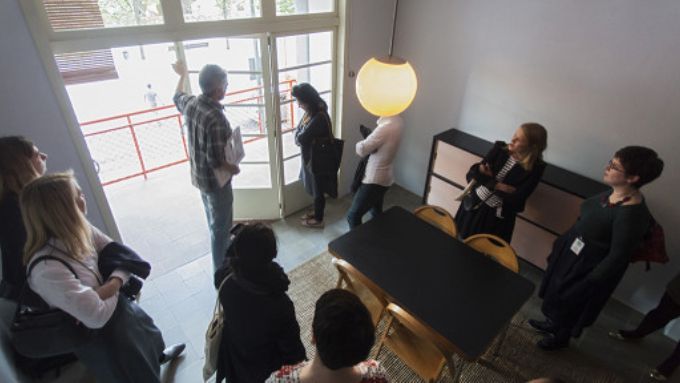
The Design Hub Museum of Barcelona is currently in charge of the guided tours that take place every Saturday in one of the building's musealized floors. Despite this clear connection, Montornés assures that both structures are "difficult to link." "Either people think the Casa Bloc is next to the Design Hub, or they don't know the building or that it depends on the museum," the critic points out. For this reason, on July 14th, two large-format photographs of the rooftop were displayed in the DHub's lobby.
In this regard, Laguillo assures that the two photographs aim, on the one hand, to reclaim the link between the building and the museum and, on the other, "to awaken the visitor's curiosity." "The Casa Bloc is not in the center of Barcelona, but on its outskirts, and that's why it was important to create a striking enough installation to make people interested in the building," he emphasizes.
In principle, the exhibition, both in the DHub lobby and at the Casa Bloc, was supposed to end this year, but due to the success of the initiative, the museum has decided to extend it until April 26, 2026. "As the organizer of the project, I had to ensure it started and ended on a specific date, but if the museum and the artist decide that the installation can continue, the door is open, and that's exactly what happened in Laguillo's case," insists Montornès, who assures that the two images "give great power" to the DHub lobby.
Uniting the Past and Present
The Past/Present project is a collaboration between the Direcció General de Promoció Cultural and the v. As Ester Martínez, Head of Support Programs for Creation and Visual Arts at the Directorate General for Cultural Promotion, explains, the objective has been "to give active artists the opportunity to work in contexts unrelated to contemporary art" and to leverage "contemporary perspectives to offer new readings of the collections in museums and heritage sites."
In this regard, although this has been the second edition, Martínez acknowledges that this time the proposal has been adapted to the needs of the artists and those responsible for the venues. "The first edition was a pilot test, and now we have tried to ensure that heritage venues and artists work together from the beginning," he details. This alliance, now much stronger than last time, "besides fostering dialogue between the venue and the exhibited work," points out Martínez, has also allowed some exhibitions to extend their life beyond the project. Furthermore, it has led to the creation of a joint installation that unites past and present, which "has motivated artists to work outside their contemporary artistic circuit to do so in very different and unique environments," he summarizes


