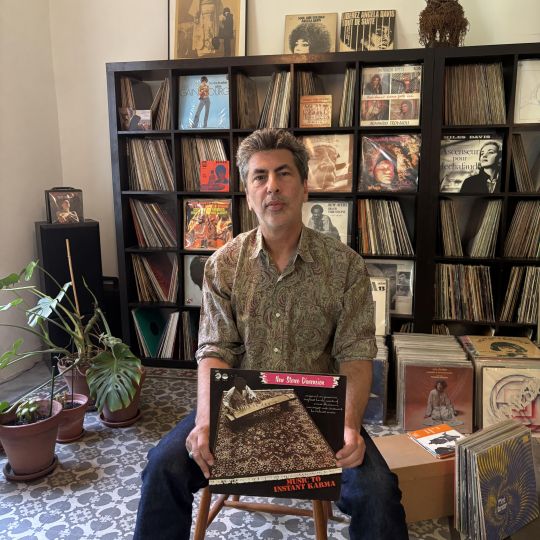
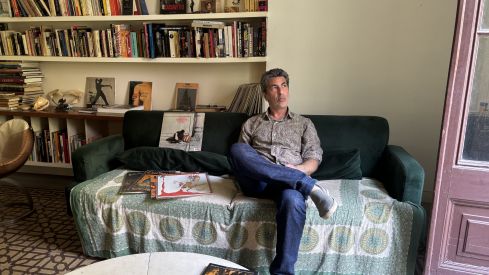
Victor Kiswell is from Paris and has been selling vinyl records for five years in his apartment on Carrer d’Avinyó, in Barcelona’s Gothic Quarter. He claims to have between 6,000 and 7,000 and knows them all. “It’s not a huge quantity, but that’s what I want: if I’m looking for a song, I know exactly where it is,” says Kiswell after putting out a cigarette. We speak in his living room in front of a shelf overflowing with albums he has bought or exchanged in Japan, Lebanon, Turkey, Italy, or Sweden, among other countries he has traveled to. He has been selling them for two decades to producers, DJs, hotels, and restaurants. You just need to book an appointment through his website, go up to the apartment, and let him recommend.
This story begins 25 years ago, when, still in Paris, this collector decided he didn’t want to direct his life towards the various careers he had pursued, but rather follow what his soul commanded, which moved to the rhythm of soul music. From a young age, he combined his job in a record store with a Biology degree. Then he studied oriental languages and anthropology, but his passion for this American style led him to sell albums that were rare to find in France at the time. “I told myself ‘I have a lot of records, I’m constantly buying them, and I have duplicates. It’s time to sell them’,” he explains. However, this music lover didn’t want to work in a “conventional store” or be “enslaved” to a schedule, but rather “be able to travel, work at night if he wanted, or receive clients at midnight if they had a performance the next day and needed records,” he specifies.
He quickly found a way to sell vinyl records that he defines as “massaging the ears.” From day one, Kiswell receives clients at home, in the immense living room where we are today. He invites them to have something to drink and together they browse and listen to music “for three hours if necessary.” In Paris, he mainly received Japanese collectors who asked him for jazz, but also Brazilian music. “I specialized in bossa nova and samba recorded by Swedish, Italian, Polish, or Spanish groups,” the seller explains.
A music seeker in love with Barcelona
In 2021, during the pandemic, he “got tired” of Paris and decided to move to Barcelona. As he explains, he knew the Catalan capital through the trips he had previously made to DJ in clubs. “I fell in love with the city: I was captivated by the architecture, the history, the feeling of freedom, the lack of judgment, the light, and, of course, the climate,” he recounts.
Once here, he has dedicated himself to collecting African, Caribbean, and Arab music albums, which he offers to all kinds of audiences. “Here, a recognized producer can come, as can a guy buying his first record. I don’t distinguish between clients; you just need to make an appointment, like with a doctor,” he jokes.
If you enter his Instagram profile, the first thing you read is that he defines himself as a “seeker of strange music,” as he has albums that are hard to find. I ask him what are the most peculiar records he has. “Editions intended for radio and television, because very small print runs were made, and fifty years later very few remain,” he comments, showing the album Stringtronics, an English edition of British library music. “It’s a highly sought-after record by collectors,” he boasts.
He specifically acquired this record by making an exchange on one of his trips as a DJ, which he uses to search for hidden treasures. This is how he introduces that in the world of collectors, one must know how to “play.” “If you have a lot of money, you can buy any record paying the maximum price, but that doesn’t interest me; the fun is finding it cheap. I look in places where almost no one goes,” he details.
In Barcelona, he browses shops like Discos Paradiso (Ciutat Vella), BCore Disc (Gràcia), or Discos Redondo (Ciutat Vella). Despite the hours he dedicates, he doesn’t always leave satisfied: “For what I’m looking for, there aren’t many shops here. If necessary, I go to Valencia, Tarragona, or Castelldefels to buy them.” But his gold mine is the ads he sees in the newspaper or on online platforms, like Todocolección, since regarding the sale of second-hand records in the city, like at Encants, he criticizes that “they are not particularly interesting.”
Once he brings the vinyls home, he classifies them on shelves, but none have a price. Kiswell details that the range goes from twenty to a thousand euros. Despite the surprising difference, he emphasizes that expensive should not be confused with better quality: “The average price of a good record, without being particularly strange, is between thirty and fifty euros.”
Most clients, expats and travelers
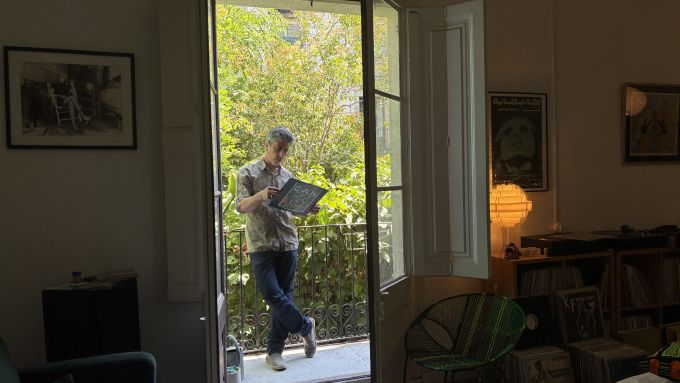
Regarding the vinyl scene in Barcelona, Kiswell, who often experiences Barcelona nightlife, considers that, on the one hand, it is a “small” sector and that “there are more people who want to DJ than places to do it” and, on the other hand, that “in terms of character, to connect with local people, it is not easy.”
And who buys him vinyls? As he explains, those who visit him most are a public that gained ground especially after the pandemic: expats or wealthy people passing through Barcelona. Asked about his opinion of this public, and even more so considering that he benefits from it, he immediately acknowledges that "it is part of the movement" because it has settled here, but he emphasizes that "one must distinguish between two phenomena: low-cost tourism and people with money who want a sweeter life." Regarding the lack of local clientele, he says he doesn't know if it's "an economic issue, lack of time, ego, fear of it being in my house, or simply lack of curiosity."
One of the current debates in the city is whether the presence of expats and the massive visit of foreigners worsen the health of Barcelona's nightlife and, consequently, its music scene. In this regard, he argues that higher quality tourism should be encouraged: "What could be done, for example, would be not to offer flights from London or Manchester to Barcelona that cost thirty euros and to promote a more diverse cultural offer. The solution is not to attack tourists who eat paella in the street."
In contrast, he believes that from his apartment on Avinyó street, he "helps foreigners discover Catalan and Spanish music." In fact, he considers himself a "seller of souvenirs," as there are flamenco-jazz records that are "a magnificent gift to take home."
Before landing in Barcelona, he liked the pianist Jordi Sabatés i Navarro, and once here, he discovered the Catalans Esqueixada Sniff, the Mallorcan Joan Bibiloni, and, among Spaniards, the Madrilenian Luis Paniagua, whom he met in person. "Luckily, even today I continue to find new records every week," he comments.
"I don't play the music people expect"
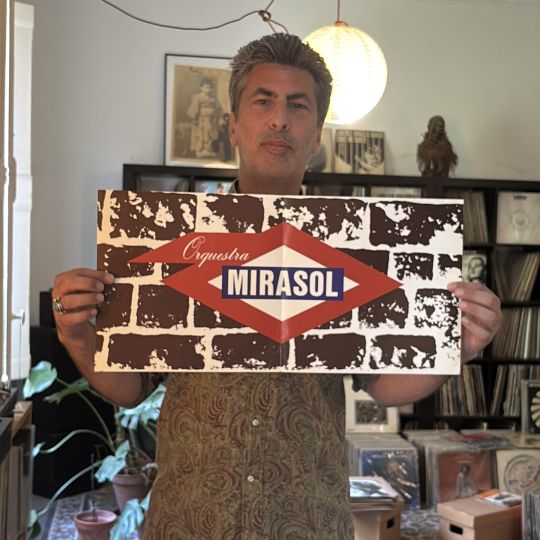
Beyond selling records, the collector lives from various projects. Years ago, he made a documentary about 1970s music in Barcelona, in which he interviewed the Orquestra Mirasol, of whom he is a big fan. He continues to work on this project today. In addition, he often takes his vinyls to various venues in Barcelona such as La Paloma, Nitsa – Apolo's electronic music parties – or La Nau. He comments that he still has to perform at Marula, a venue right next to his home.
What he enjoys most about the night is the "risk" of mixing such different sounds: "I don't usually play what people expect, I like to break out of the routine because I can play two Latin music songs, then an African one, an Arabic one, and go back to Latin. This mix is precisely what makes each session more interesting."
Finally, as it had to be, we finish the conversation in front of his two turntables. He pulls out the album Salsa catalana by the Mirasol orchestra, signed by its members, whom he met a year ago. "One of them lives in Gràcia, it's close to me," he says with a wide smile.