
Originally curated by Janice Li, the exhibition has featured the local curatorship of Blanca Arias and Júlia Llull. An exhibition that can be seen until November 8, 2026, and brings together works, documents, historical objects, and contemporary installations to think about beauty as a changing construction, traversed by politics, religion, medicine, the market, gender, race, and class, critically analyzing how beauty canons construct us, which ones are marginalized, and what space of freedom we have left to subvert them. The exhibition will be accompanied by an extensive public program, with conferences, guided tours, an intense and extensive film program, an educational program, and creative activities, in collaboration with institutions such as the creative space Còrdova.
The space we inhabit is changing, plural, artificial, and utopian, increasingly marked by the power of the aesthetic industry and by the empire of the selfie and social networks. The irruption of artificial intelligence has multiplied the copy and artificiality of the beauty canon, turning bodies into objects of worship, in an economic and social key. At the same time, it has expanded and diversified the possible representations and ways of defining beauty, amidst an uncertain debate conditioned by political, economic, moral, and cultural hindrances. Beauty, a quality that has historically delighted and satisfied our senses and intellect, is in tension, more than ever, in a society of transparency, as philosopher Byung-Chul Han argues, which has turned us into homogeneous individuals trapped in a constant back-and-forth between being equal or disparate, sharing tastes and ideals or rejecting each other mutually. The exhibition, commented Judit Carrera, director of the CCCB, not only "traces a fundamental aesthetic category that traverses the art of all times, but also offers a lens from which to promote a critical view of the contemporary world."
Janice Li made it clear that there is no definitive answer to the question of what beauty is. The exhibition explores why, since the beginning of human history, there has been this incessant search for beauty, explored as a complex belief system, which is shaped by everything around us, but which remains personal. For this very reason, The Cult of Beauty invites the visitor to a process of self-discovery, providing a space where everyone can explore themselves, without judgment, to discover how to arm themselves and recover amidst this aesthetic and moral industrialization. Júlia Llull maintains that this second version is born from the intention of exploring the power of dissidences when confronting the aesthetic canon, which has been an excuse to subjugate bodies and territories. “Under the banner of beauty, much ugliness has been produced in the world,” states Llull.
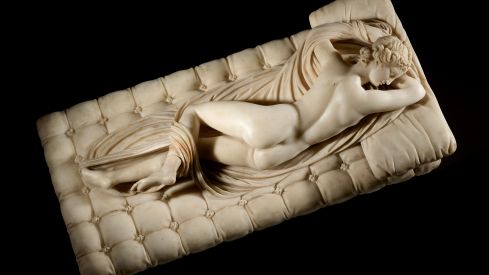
The exhibition takes as its starting point the canon established by classicism, which equated beauty with proportion, virtue, and order. The visitor initially dialogues with a venus, the Idolino of Pesaro, and Bernini's Sleeping Hermaphrodite. The first two transport us to the serenity of the Renaissance, almost making us feel inside Sandro Botticelli's “Birth of Venus,” or giving life to Johann Joachim Winckelmann's “Reflections on the Imitation of Greek Works.” The Hermaphrodite, however, is a cry for suspicion, warning us that perhaps the canon and the normative need to be dislodged, to question whether beauty goes further. Aided by the artificial voice of Aitana López, the first non-human influencer created in Spain, who repeats “packaging changes, but the pressure is the same,” these first works suggest that perhaps it is necessary to overcome the coldness modeled by static images, induced by market logics and deeply homogenized. From here, the exhibition navigates around three main areas: the ideals of beauty, the self-image industry, and the beauty of the flesh, to question what beauty has been in art and history, what it demands of us in our own present, and what it could become if it disobeyed traditional canons.
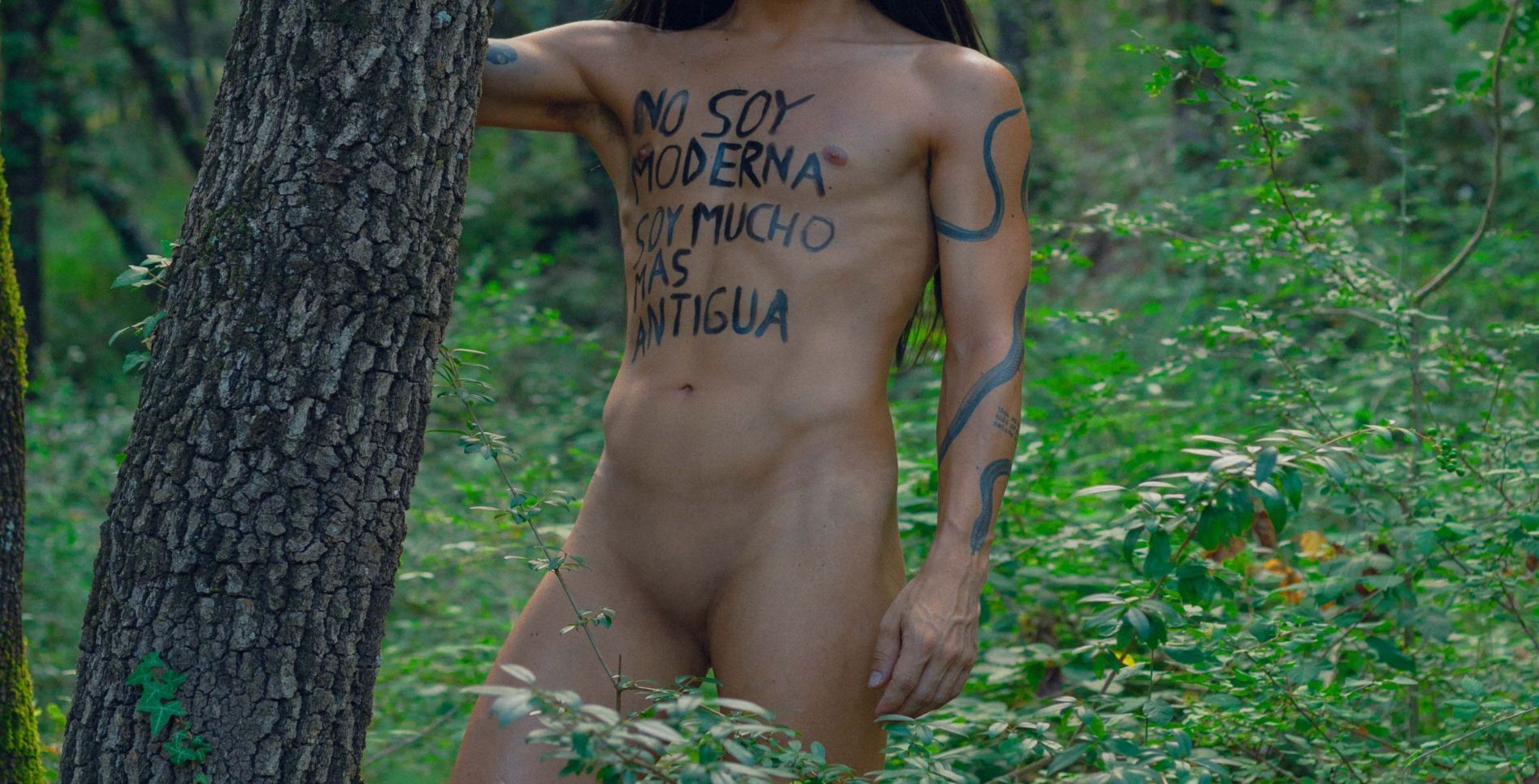
“The ideals of beauty” are not sustained solely in the aesthetic, but are built from a profoundly diverse social, political, and religious context that plays a fundamental role, and that have made the body and image one more element, open to valuation and judgment. The first room hosts works by local artists such as Sandra Gamarra, Lorenza Böttner, Carlos Motta or Colita. The photograph “No soy moderna, soy mucho más antigua” by the artist Norma Pérez dialogues with the initial works, claiming how non-conforming beauties have existed since before coloniality announced them, to claim that not only the ideal is ancient, but so is resistance, reminding us of the fluidity and arbitrariness of these aesthetic categories. Our history about the world begins much earlier, in the prematurity of the Paleolithic, and the exhibition reminds us of this. The room places in the middle a display case with various venus figures, which overflow the harmonic and standard canons that we have inherited from the classical world, to make clear how history is a limit to the very reflection of beauty.
The “Virgin of Guadalupe” (1745), which represents a black Madonna, or “Krishna with Radha and three Gopis”, from Calacutta Art Studio, which represents this Hindu deity, also black, amidst the divine dance of Rasa Lila, subvert the will of many of the works, conditioned by an aesthetic imposed on ideals and communities, as a narrow path to define beauty.
The historically static representation of women, framed in morality and moderation, is contrasted with deformations of the canon, which aim to be a way of subverting aesthetic impositions, demonizing them, or opposing them. Juno Calypso proposes works such as “Slendertone I” or “A Girl's Guide to Egg Freezing - Step 3 The Harvest”, images of women who exaggerate aesthetic modifications in a pop style, like a wink to the original prism, to the construction of a social image, but which hides ugliness. Because beauty has never been an innocent fact, but has constantly hierarchized and ordered society around representations of femininity that responded to purity, youth, and virtue.
Aesthetic dissidence is the counterpoint of this exhibition, which with artists like Isidre Nonell, Ismael Smith, Josep Masana or Marià Fortuny, teach us that when you relate the canon with other forms and contexts, it becomes different and, above all, wounding. It ceases to be a pleasing object, as happens with orientalism, which delimits and classifies a beauty, typifying and defining where the beauty we can sustain ends. Or how the Roma collective materializes, represented in works like “Portrait of a Young Gypsy Woman” by Julio Moisés, or the photographic series by the artist Colita, where the Roma community takes agency, within its stereotypes, but from its own dynamism and genuineness. Works that portray how we have benefited from whiteness, to exclude those bodies affected by the canon.
Beauty also surpasses corporeality to guide us into the aesthetic experience through smell, touch and hearing. “Beauty Sensorium”, by Baum & Leahy, recovers cosmetic recipes from the Renaissance and vindicates feminine knowledge linked to chemistry, botany and care, often expelled from official scientific narratives.
The second area drags us towards the self-image industry, to that massive commercialization of beauty products that marked the 20th century, but reminding us of its oldest origins. From powder boxes of ancient Egypt to cosmetic products of the Renaissance, passing through new forms of aesthetic marketing, beauty has grown in dialogue with humanity's obsession with its own image, always perfect, reaffirming beauty as cultural capital and as a source of economic benefit. We immerse ourselves in a reflection on the play and disciplining of the body, which begins as early as childhood, to understand the role of fashion, aesthetics and advertising in the inclusion and exclusion of corporealities.
The artistic practice seems that it could be a device of power to reproduce the canons, but precisely this exhibition shows us the opposite, teaching us how art never fully obeys the systems of power, and always leaves a margin for analysis. The works by Eulàlia Grau or Roberto Marrero, such as “San Jorge” or “San Sebastián (Bob Mizer)”, explore pop culture, but adding elements that tension masculinity through collage, humor, desire and irony, reclaiming the right to shape our own desire from imaginaries that, precisely, are responsible for managing it. And the myth of Narcissus reinterpreted from contemporaneity, illustrates how technological advancement has allowed us to modulate our image to become what we desire. Virtual reality simultaneously allows and limits the construction of aesthetic ideals, and that is why it is conceived, in this exhibition, as a revolutionary space, but one that can become what most consolidates the regime of power. The installation “Mirror, Mirror on the Wall”, by Xcessive Aesthetics, relocates this tension in a semi-public and intimate space at the same time: a nightclub bathroom; a place for confidences, makeup touch-ups, selfies and complicities.
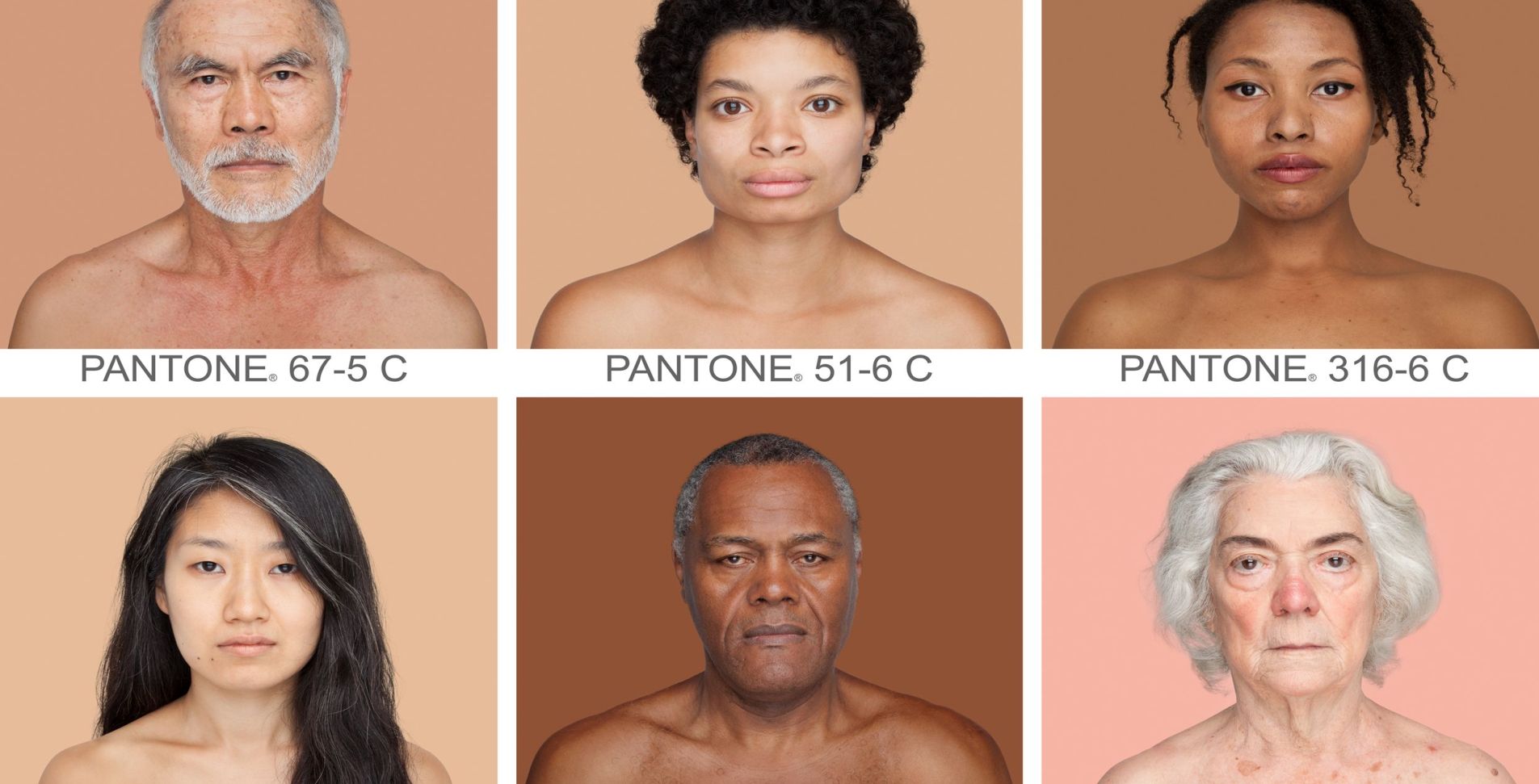
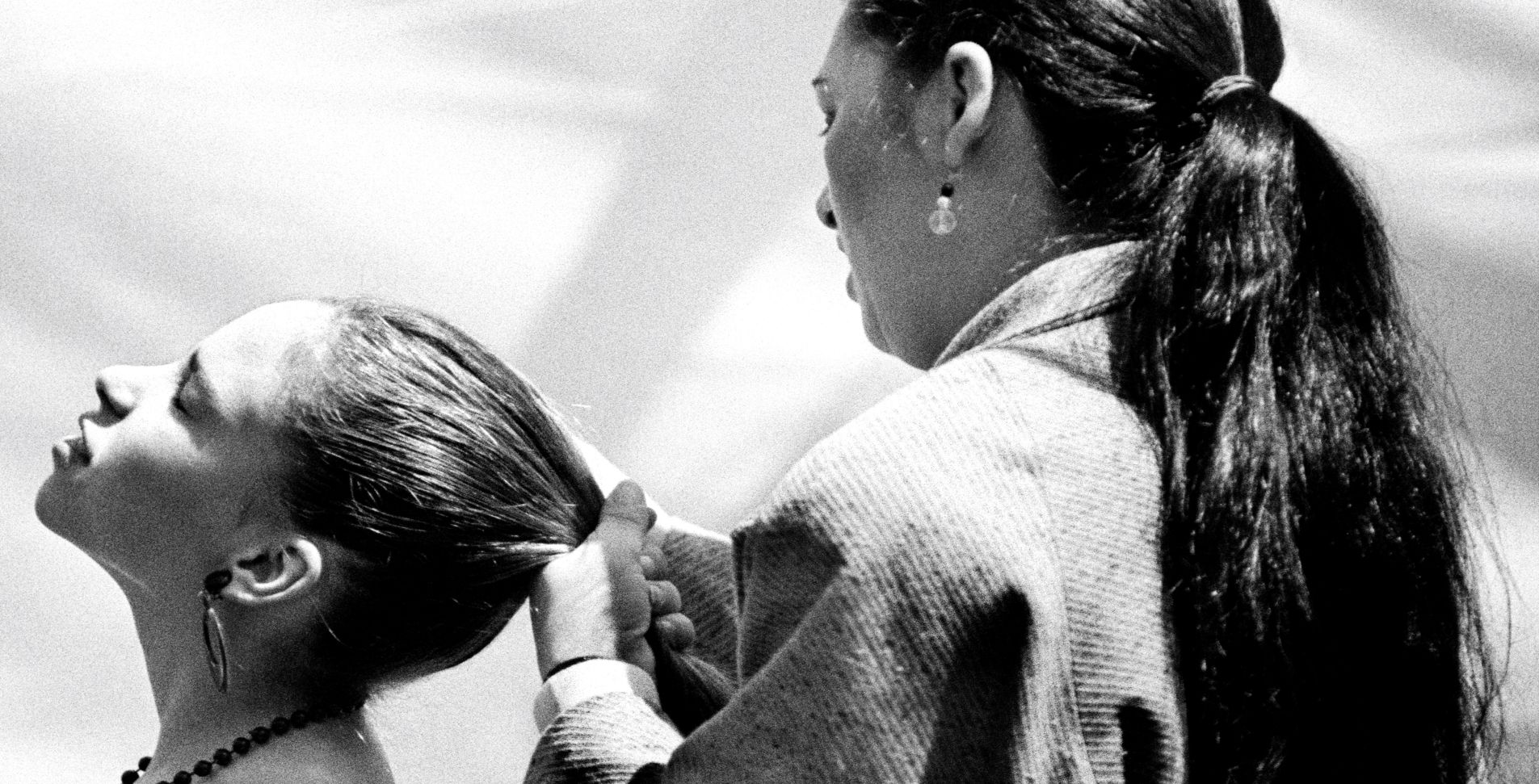
“The beauty of the flesh: overflowing the canon” is the third area, which closes this exhibition with newly created works such as “The Disobedient Nose” by the artist Shirin Fathi, where the nose is transformed into an insubmissive organ, like a part of the face that refuses to be domesticated by surgery, social gaze or the normative ideal or “Humanae” by Angélica Dass which demonstrates that race and identity cannot be reduced to skin color. We see video creations such as “Carry That Weight” by Ren Buchness, an artist who works with the plasticity and transversality of the body to claim a beauty of his own and break with imposed forms, or “Natural Self-Portrait #8” and “Stillness #27” by Laura Aguilar, photographs that show a symbiosis between the human body and those not-so-human forms. Works that want to claim how the body is vibrant and always living matter, available to articulate experiences. Claiming the flesh, but also the hair, as an exercise of oppression, or as a way to modulate oneself and create an alter ego. “Narcissister” is the installation that closes the exhibition, and which focuses on the overwhelming weight of beauty ideals that have been transmitted from generation to generation. A three-meter anthropomorphic sculpture, loaded with objects from the artist's mother, crystallizing the tension between accepting inherited beauty and redefining it.
Thus, El Culte a la Bellesa demonstrates that beauty hurts, excludes and disciplines, but that it can also be a space of pleasure, community, play and emancipation, a space of its own. As in that convulsive beauty of the surrealists and vibrant beauty of the impressionists, the exhibition claims to dispute beauty, tear it from the canon and return it to the body, to matter and to the forms of life that still resist being reduced to the perfect image.


