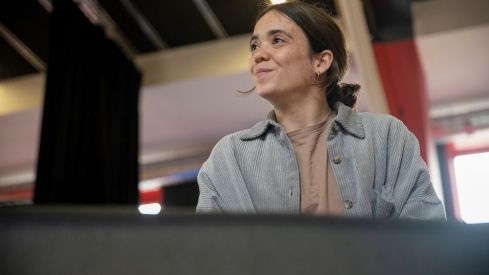
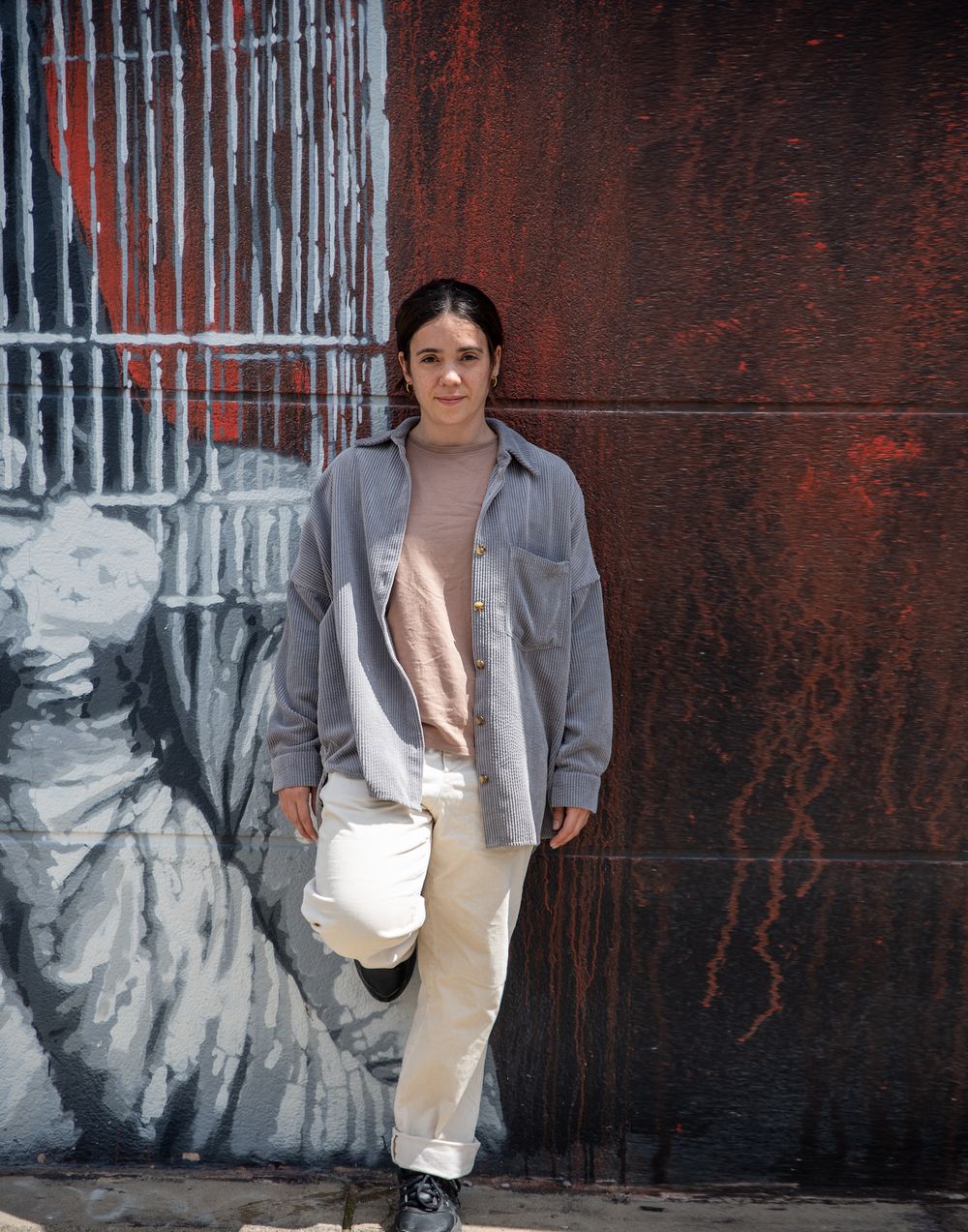
Agnés Sales assures that she expresses herself better through movement than through words, which is quite normal if we are talking about a dancer. During this conversation at the Ateneu Popular 9 Barris she demonstrates a certain shyness, but she puts it aside as the interview progresses. She explains herself well and has clear ideas, despite recognizing that it is not usual for her to be interviewed. Sales, born in Barcelona and currently living in Montornès del Vallès, is co-director of the company Agnés Sales & Héctor Plaza. She is 33 years old, but movement has been part of her life since she was three, when she started doing gymnastics.
You started your career as a gymnast. Until what age did you dedicate yourself to it?
I started very young, at three and a half years old, and I did it until I was 16. It was a very intense period. I trained every day for four hours. And also on weekends at the High Performance Center in Sant Cugat... In reality, it was the beginning of my career, because it was where all the discipline began to be cultivated. I was a girl who did gymnastics, but, for example, I invented all the dances in gymnastics.
There was already a creative part.
Yes, and in connection with music and dance.
This discipline you were talking about, with the age you were, must have been a bit wearing, right?
Yes, but I prolonged it because I enjoyed it and liked it a lot. Obviously, there is this part of discipline, but there was also self-improvement, overcoming your fears... Gymnastics helped me with all of this, but it is true that when you reach adolescence you want to try more things.
Then came the leap into the world of hip-hop.
Yes. I had some skates and I skated in skateparks, where I started to meet people, to listen to hip-hop music... First, I did the typical after-school activity and then I discovered hip-hop freestyle, house and then breakdancing.
Speaking of visibility, but of a different kind, in 2017, in the same stage, you were part of the show Billy Jean. It was a piece that raised the limits of human exposure combined with the desire we all have for privacy. Is dance a discipline where there is a lot of exposure? As an artist, do you expose yourself a lot when you dance?
It depends on the theme. You do expose yourself, because people look at you and you are the center of attention. Depending on the theme, and what you are creating, you expose your thoughts more or less or you expose yourself more intimately. Or maybe not. You can do something that is just movement and does not talk about any emotion.
Does dance, at its core, have, let's say, primitive roots?
That is, humans, when we are very young, can already dance, or something that resembles dancing, before speaking.
What I feel is that we are much more connected to movement than we are in adult life later on. We could talk about what dancing is, but moving and exploring movement is what children do non-stop. That's incredible, as is connecting with that as adults, because many people forget about their bodies, about playing with them, about what movement capabilities you can have, what your body needs, what tensions you have... Then you see adults who spend many hours in front of the computer and whose bodies are not connected to themselves.
We probably often forget that the body is part of everything.
It's just that in the end, emotions are also channeled through the body. And if we don't treat them, whether through emotion or from the body, there is a blockage that stays there.
In fact, I was reading some statements by the dancer Dácil González who said in an interview: "I prefer dancing to talking." I don't know if the same happens to you.
Totally. In fact, this interview generates a bit of anxiety for me [smiles], because I express myself much better through dance than through words. That's very clear, and that's why we dance. And there are also things that cannot be said with words. Sometimes words allow you to be specific, while movement is more abstract. And there are thoughts and emotions that are more abstract. Dance can reach those places more. In fact, when you introduce the word in a show, the audience is much more oriented. And when it's something more abstract, people can make their own movie more. The word contextualizes a lot.
Going back to your career, in 2019 you were part of the Circ d'Hivern, a production of the Ateneu Popular 9 Barris, the place where we are now doing the interview. What does this space represent for you in the world of performing arts?
The Ateneu was a place where I felt very welcome, and it still is. I feel that people are very aware of respecting the artist. As a space, it is also very connected to the neighborhood, they work horizontally... It is a special place that is worth discovering.
A moment of discovery.
Yes, I connected with the fact that I could do whatever I wanted. There was no one telling me "it's 20 repetitions of handless wheel", for example. It gave you freedom of creation, of being able to express yourself... I found a place, with urban dances, where I could be myself.
I work quite a bit in France and I'm amazed, because there the theaters fill up in all the towns
Surely one of the problems, if we look at the cultural map of Barcelona and the metropolitan area, is that there aren't many places like this.
Exactly. And here there are many opportunities. The Winter Circus, for example, is directed by different people every year and the artists also change. And they try to focus on the person who is here so that they feel welcome, that the economic conditions are good... They take great care of the artist. When I started with the Winter Circus and saw the schedule, the organization... There was a space that said 'Care' and I was amazed. I had never seen it anywhere. Within a creation, which can be a very intense moment and you live with many people, emotions and egos, that there was this space in case it was needed seemed incredible to me.
Besides the spaces, and if we talk about the current offer, what is most done is street performance. Is it the format that currently attracts the most people?
I think that's very good, because it brings in new audiences. And people who wouldn't see dance suddenly do. This makes it more popular and for everyone.
Of these shows, the ones that usually work best are those that last about 10 or 15 minutes. Beyond the physical toll that such a format takes, I don't know if you think the short ones work because dance doesn't escape the cultural consumption marked by brevity and speed...
I couldn't say for sure. I work quite a bit in France and I'm amazed, because there the venues are full in every town. In the smallest town, and the one you least expect, the venue is full. That surprises me a lot. Here we have a cultural tradition that means we don't go to venues as much, but we prefer to be outside, have a beer, enjoy the weather... And suddenly there's a dance festival. The feeling is that it has more to do with that.
Is the cultural and interest landscape you find when you go to France more rewarding than what exists here?
Regarding the appreciation for art and dance, the truth is that you do think: "I would love it if it were like that in Catalonia."
But it's not like that…
But little by little… The APDC (Association of Dance Professionals of Catalonia), for example, is fighting hard and moving things so that there are changes. I see it with optimism.
And what about large-format, in-theater shows, is it more difficult here to have guaranteed performances and enter a circuit, even with a consolidated career?
We, as a company, would really like to do a long piece for the theater, but it's difficult. And as for money and grants... It's complicated.
You don't get much help from the public sector, do you?
No. And to get it, you have to make a huge effort while you're earning money doing something else because you have to live. There's no time to look at all the grants that exist. Sometimes you just lose the will to do it...
The first time I got paid to dance, I couldn't believe it
This is a complaint from the entire cultural sector.
Sometimes Héctor and I talk about how incompatible it is to spend a whole morning in front of the computer looking at a call for applications or a grant with going to the studio to create things. You use a different part of your brain and you arrive at the studio
and you no longer have ideas.
Your creative capacity is almost invalidated.
Exactly, that's what I meant. It would be ideal to have someone to help you do all this.
This is linked to the problem of precariousness. This word is always there...
Yes, there is a lot of precariousness. I always tell my friends that the decision to dedicate myself to dance is not intelligent [smiles]. What happens is that I don't see what other decision I could have made, because I wanted to do this. But you live in a very precarious situation and many times you wonder if you want to continue, because you think about the future and say: "Do I want to be like this forever? Just surviving? I don't know..."


