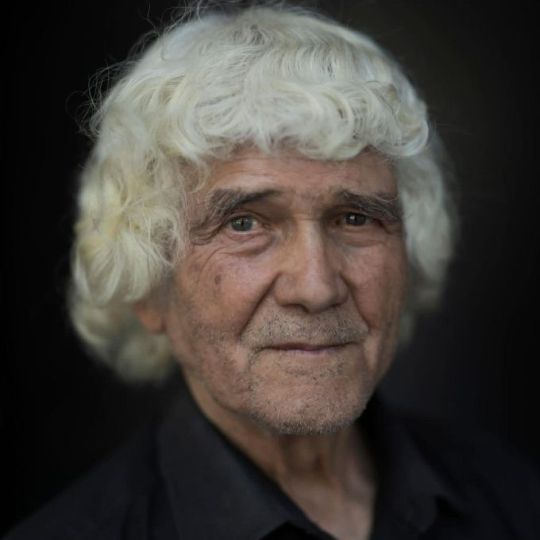
In the 1980s, in the Brazilian city of São Paulo, there was a boy, the son of Asturian immigrants from a well-off family, who, at just 8 or 9 years old, got used to visiting the favelas, the large precarious settlements found in the country's cities. It was a place where he wasn't supposed to be, but he felt comfortable there and played with other children who did live there. At that moment, Sasha Asensio didn't know it yet, but that would mark his life.
It's been about 45 years. We're in the Raval neighborhood, where Asensio has lived for two decades, always in the same place, on Reina Amàlia street. It's 9 AM on any given Thursday. This photographer, as he himself confesses, lives with an obsession: he has always felt an attraction to the most helpless. An obsession that was surely generated by the memories he kept in his mind from the first part of his life in Brazil, and which has led him to build a professional career focused on portraying people from different neighborhoods around the world who haven't had life smile upon them.
“This neighborhood is like the bar from Star Wars,” says Asensio, referring to the wide variety of characters of all kinds there. “Now we are on La Rambla del Raval. From here to the left (looking up) things change,” he says. He's talking about the area with the most poverty and social problems of all kinds. He argues, as he also does with his photography, that we must avoid euphemisms and show things as they are. “We have to speak plainly and say things clearly. In El Raval there is vertical homelessness, we must not fall into the strategy of concealment,” he says.
And what is the background to his particular story with this Barcelona neighborhood? It's all thanks to the photographer Joan Colom, best known for his photographs of the Raval, at the time the "barrio chino," during the sixties. "I saw an exhibition of his in Gijón, at La Barjola, about twenty-something years ago, and it fascinated me. From then on, I started visiting the neighborhood until I came to live here. And people would say to me, 'But where are you going?'" Well, Asensio was going to a place "with its own idiosyncrasies and a very large population density," a neighborhood with many layers of history that have led us to talk about a practically untamable part of the city, where many people live who have the characteristics to end up being portrayed by him: "The work I do has a celebratory aspect, the people I photograph have their own light." He sees this own light, for example, in all the people from the LGTBI+ community who "seek refuge here in the Raval," as he himself says. It is precisely one of the many paradoxes that coexist in this neighborhood. For all the entrenched problems it may have, it also ends up generating networks of solidarity among people who perhaps could not be created elsewhere.
LGTBI+ Refuge and Drug Tourism
We continue our walk through the neighborhood. We are on Carretes street, where we cross paths with a group of volunteers doing cleaning work. Further on, as we walk down Cera street and pass by the Umair Qamar hair salon, Asensio greets one of the employees from a distance. Or perhaps it's the owner. He moves through these streets like an office worker in an office. "Robadors street is mine," he says, laughing. There are many interesting people to photograph there. And, speaking of Robadors, he reflects on the demographic changes. "The migratory flow has changed a lot. The typical old people who came as young people from different parts of Spain are almost gone. Now it's all current immigration," he points out.
He walks, but stops to talk to two boys who have caught his eye. When he sees potential 'models' he doesn't know, he deploys the street smarts of someone who knows the streets. He greets a Dominican with almost his entire face tattooed, who is with a young Moroccan. The latter looks at him with distance, but suddenly Asensio greets him, speaking a few words in Arabic, and everything changes. Smiles and complicity. Perhaps one day these two boys will end up on the photographer's camera's memory card. "Moroccans usually don't let themselves be photographed, whereas Pakistanis almost always do," he explains to me
Speaking of nationalities, now that we've found a Dominican guy, Asensio recalls the bizarre story that allowed him access to a drug den to take photographs. "I met a Dominican guy who ended up in prison. Once, when he was incarcerated, he wrote to me asking for money and I sent him 30 euros. When he got out, he wrote to me to say I was the only one who had helped him. He immediately started managing a drug den and let me in," he explains, still surprised by the story.
We arrive at Plaça del Pedró, this triangular space that is a meeting point and always bustling with activity. The obelisk in the center of the square commemorates Saint Eulalia, the patron saint, as legend has it she was crucified here. The large number of pigeons present also contributes significantly to the scene. We take advantage of the stop to continue discussing the neighborhood. "Just as I told you it's a safe space for transsexual women, for example, there's also drug tourism in Raval. People come here from many places to get high," states this photographer. Unfortunately, he says, he currently sees "the worst Raval" in the 20 years he's lived here. "There's a lot of poverty and incivility. Many people throw their trash anywhere, and the cleaning service is terrible. People here have customs from their places of origin, and things are how they are. There's nothing wrong with saying it, and I believe I have the authority to speak about Raval," he adds bluntly.
"I see beauty everywhere"
We return to photography. The subjects of Asensio's portraits would be described as marginalized people by a large part of society. And it could certainly be accurate to speak in these terms, but in the end, it all depends on the perspective. And this photographer's perspective is not exactly conventional. "I see beauty everywhere and I have a weakness for people who are missing things. I create bonds through photography, but before that, there's a whole process of seduction so that the person ends up blossoming in front of the camera," he explains. "I try to make the photo give them self-esteem, to reflect their light," he adds.
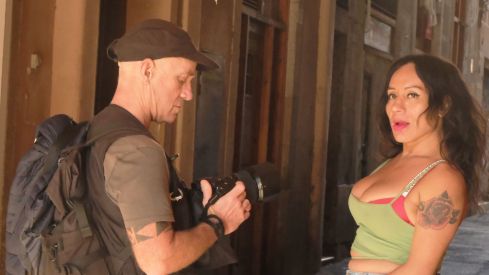
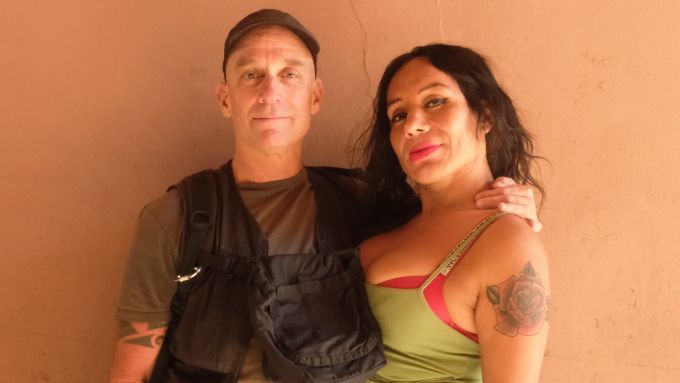
A short while later, it's proven that his words are not an empty speech. Our route has taken us to Sant Rafael street, and just as we pass by Bernadí Martorell passage, which has a dark and grim entrance, a voice addresses Asensio. It's a transgender prostitute who, upon seeing Sasha, calls out to him. They greet each other effusively, as they've known each other for a long time. Then, she asks him to take her photos, and he takes out his camera. For about 10 minutes, I observe the scene. He photographs her, gives her instructions on how to pose, she's comfortable, she smiles at the camera. A connection is generated, and I understand what he was telling me a while ago about the light that emerges from the protagonists of his photos. People who, if they have anything, it's not an easy life, but who perhaps for a few moments feel like the center of the world. The camera focuses on them, and at the moment it clicks, in that precise instant, they think of nothing else but that photo.
"With age, you train your gaze"
Regarding photography, Asensio has a very clear message. He breaks it down for me as we head to the MACBA. He believes we are "boxed in" and that social media has standardized the world of images. "I see myself as someone who acts as a lever against the selfie. What interests me is aesthetic dissent, but I always seek it through the horizontal relationship I have with photography," he states. This horizontality, treating the people he photographs as equals, is one of his non-negotiable principles. In fact, I've observed that there's also a social component to his work. "One day, at the Padre Ángel Church in Madrid, a volunteer told me that the photos I took were very good, but what was valuable was that I spoke with people," he recalls. And it's evident that his photographs wouldn't be possible without a prior conversation – whether short or long – or a closer relationship with the subjects.
We arrive at Plaça dels Àngels, at the MACBA. Asensio confesses to me that his "greatest dream" would be to have an exhibition there with the photos he takes of the people of Raval and for "the museum to be filled with people from here." In fact, he is quite critical of this cultural space. He considers that there are usually not many visitors and that it lives somewhat detached from the neighborhood. "When they have openings, there are no neighbors. I would like the museum to be filled with faces from Raval," he adds. And, although more underground cultural spaces are always a good place to exhibit, in reality, there is nothing more dissident than breaking the mold. And making an appearance at the MACBA would undoubtedly be that. "Exhibiting the people of Raval there is a challenge that I believe is necessary," Asensio concludes