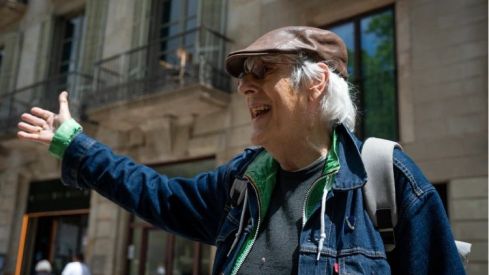
An elderly gentleman accompanied by two dogs waits calmly in front of the Liceu until we arrive to greet him. He is Joan Estrada, artist, promoter, ramblero and, lately, producer and director of the documentary Ramblas. We quickly flee the shelter of the Gran Teatre, "a symbol of the Catalan bourgeoisie," as Estrada defines it, and move to the beginning of the route, just on the other side, in every sense: the Cafè de l'Òpera.
"At first I had an apartment on Banys Nous street that I shared with Oriol Tramvia and two other people, but we lived our lives here," he says, pointing to the terrace of this historic cafe. "You'd sit there all alone at four, and two hours later it was all yours because all sorts of people passing by would join in," he adds. Protests, performances, and even demonstrations were planned there. "When Franco dies, the space is the Rambla, from Zurich to Colom. We never closed, this was a 24-hour space for demands," he recounts.
We advance with difficulty amidst the dust and noise of the remodeling works. Our photographer performs authentic feats to dodge the workers, fences, and machinery. With the two dogs, a greyhound in pajamas named Bibí and a defiant dachshund named Mimí, we form an unusual company that attracts the gaze of tourists and passers-by. Talking about this and that, we arrive at the second point of the route, somewhat marred by the rehabilitation works, which have left it unrecognizable. It is the Teatre Principal, where the famous Cúpula Venus was located, which our protagonist invented in 1978 and directed until 1986.
Cúpula Venus, "the first alternative venue"
"The story began one September morning in 1978," he starts. Joan was part of the theater group Roba Estesa. "We did street theater so we could reach everyone, and we specialized in German cabaret," he explains. They had triumphed at a Mercè festival and were looking for a place to settle. He himself mentioned it that morning on one of those collective terraces where, among others, Ocaña, Federico Jiménez Losantos, and the writer Alberto Cardín sat. "Ocaña interrupted me and told me there was a perfect place where Bigas Luna had just shot his first film, Tatuaje. It was above the Cinema Principal," he adds.
Indeed, above what was then a cinema, there were the Billares Montforte and a lot of available space, but the owners of the building, the Balañá family, wanted to charge for it. "I proposed to Mr. Datzira to create the cultural section of Billares Montforte and become the resident group," says Estrada. And it worked.
That's how the Cúpula Venus became "the first alternative venue" in the city, a breeding ground where artists like Tortell Poltrona, Loles León, Pepe Rubianes, Ángel Pavlosky, Gato Pérez... consolidated their careers. "Fellini's clowns came, and a Peruvian transvestite named Samanta also performed there," he recalls with joy. But that couldn't last long. "The luck we had at the beginning was the misgovernance in the city. Mayor Socias Humbert had the foresight to bring Elisa Lumbreras for the culture area," a communist militant from Cuenca who was very clear: "The first thing was to recover street culture."
However, over time, trends changed. "There were many management problems and one day Joan de Sagarra, who was the Culture delegate, took away the two pennies they gave us." "At the dome, we did fantastic things, but we were not official culture," he laments, and "they let it die." It closed on January 7, 1986, and in October, the Olympic Games were announced, which were "the perfect alibi to hijack the memory of La Rambla." "The history of Barcelona went from Franco's death to the Olympics," Estrada believes. But, who committed the 'crime'? "There are three horsemen of the apocalypse: AIDS, heroin, and Pujol," he replies. And, to make it very clear, he adds: "For Convergència, all of us were communists, anarchists, whores, faggots..."
Jumping to the present, and before continuing to walk, Estrada is not entirely confident about the future reopening of the Principal. "I don't want to comment," he excuses himself. Although he doesn't hold the suspense for long: "This discourse that we will recover Paral·lel as it was, the Molino, the Principal, the Boqueria... tires me greatly. We are doing cultural trickery."
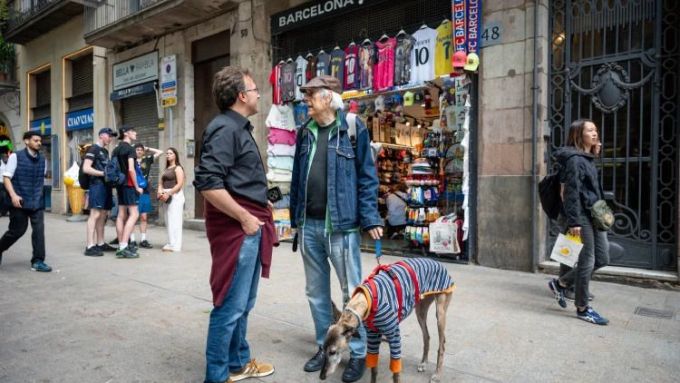
The documentary 'Ramblas'
We continue walking and arrive at the last point of the route, number 15, on the Rambla de Santa Mònica: “After living for a long time at number 48, I came here. My neighbors were Sisa and Gurruchaga.” His favorite kiosk is still there. “I would look out the balcony at dawn and go down when I saw that they had brought El País,” he recalls. It was a time when kiosks were open 24 hours, the same time when “transvestites prostituted themselves” on the corner of Santa Mònica street, “and then worked in some cabaret imitating Maria Jiménez or Sara Montiel.”
This is the Rambla that Estrada and his friend Manuel Iborra have recovered in the documentary series Ramblas, premiered in Madrid on May 2. They did it there because the Sala Berlanga was very interested in this proposal from two “outsider old-timers,” but not so much in Barcelona. It is no coincidence that it was screened within the framework of a cycle called Barcelona: la memoria secuestrada (Barcelona: the kidnapped memory), a title he himself chose.
The documentary evokes that moment of the promenade and of Barcelona’s history when “you didn’t even know where you lived or who you would sleep with that night, you lived in the moment.” It gathers the testimony of twenty-five “rambleros” from the seventies and eighties and has a particularity, very much of that era, too. “It’s made without a penny,” says Joan, proudly. “From the beginning, I wanted to do it that way. Not a single public euro, not a single private euro that isn’t ours, as we would have done it back then.” That’s why “the documentary has an underground flavor, which is nothing other than the soul of the Rambla,” he concludes.
Joan is pulling some strings to be able to show the documentary, although it is not easy. He is also looking for a distributor so that everyone knows: “There is a lot of talk about the Madrid movida, but on the Rambla there was real movida.” And all that endures, for example, in Loles León. “They didn’t want to give her the City Council’s Gold Medal, some because she’s a communist and others because she’s not Catalan,” he denounces indignantly. “Loles is more Catalan than all of them. She’s from Barceloneta and represents Barcelona better than anyone,” he states.
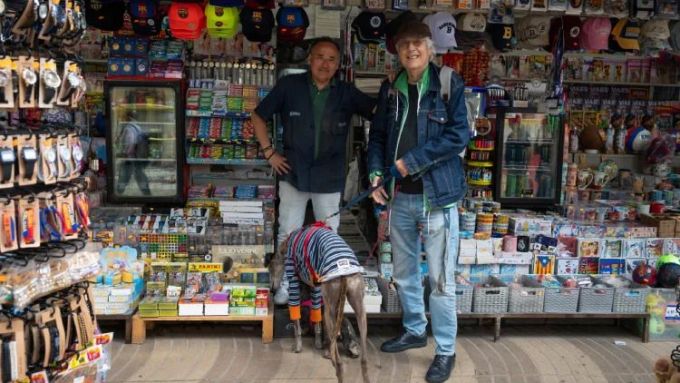
We leave Joan, Bibí, and Mimí with their trusted newsagent. We say goodbye after a magnificent walk and a touch of melancholy. "I have lived 50 years on La Rambla," he confesses, anticipating something important: "I reopened the Cúpula Venus, I promoted the Rambleros tent in 2010, which was a tribute to that whole generation, but I am not a ramblista... Perhaps it's because I am ramblero."


