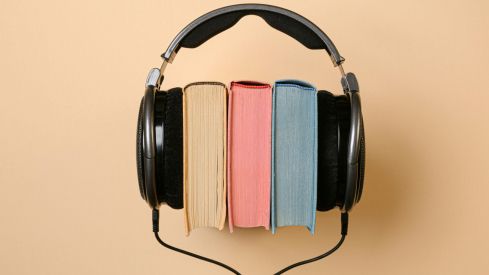
Reading while washing the dishes, driving or taking a walk around the city has long been possible with audiobooks. But what was once a practically residual market now seems to be gaining momentum. According to data from the Survey of reading habits and book purchasing in Catalonia, from the Catalan Institute of Cultural Companies (ICEC), published this April, audiobook consumption has doubled in five years, going from 3.8% of people who listened to them in 2019 to 8% in 2024. Furthermore, other state-level surveys indicate that 4.5% of the Catalan population has consumed audiobooks in the last three months and that, on average, they have listened to up to four copies.
However, what exactly is the state of the sector in Catalonia and in the metropolitan area of Barcelona? And the publishers, do they perceive it with good eyes or as a threat that can displace the traditional book? We analyze it from the hand of experts.
A growing sector
Unlike the Anglo-Saxon world, Catalonia and the rest of the Spanish State do not have a consolidated tradition of the audiobook. The United States started with this format in the 70s through CD and cassettes, but in our country, the first companies that promoted the genre in Barcelona only date back 10 years ago, with chains like Storytel.
Since then, platforms like Audible, Spotify and Ivoox, among others, have tried to fatten the catalog of titles to activate the industry, but they have found a market that is not profitable for them. "The investment in production and infrastructure to make an audiobook is still very expensive for the little economic return it has," assures Eva Güell, collaborating professor of the Studies of Arts and Humanities of the Universitat Oberta de Catalunya (UOC) and expert in the publishing world.
Güell points out that the costs of audiobooks can climb up to 250 euros per hour, and require a specialized stylistic and artistic direction. "The editing of a traditional book and the production of an audiobook are totally different, because the latter entails questions that would never be raised in the traditional format. Is it necessary to do the full reading of the book or shorten some parts of it? Are the characters interpreted when they speak or is more than one voice used?", exemplifies Güell.
"The investment in production to make an audiobook is still very expensive for the little economic return it has," assures Eva Güell, professor at the UOC
Aside from the costs, in Catalonia citizens do not want to buy online cultural materials. "They prefer to consume them for free and do not see them as a product they have to pay for," summarizes Lluís Agustí, professor at the Faculty of Information and Audiovisual Media of the University of Barcelona (UB), also an expert in the publishing world.
In addition, when potential consumers try to access this market, they realize the low availability of "desirable" titles, a fact that, at the same time, distances them from the audiobook. "In general, if you are a person who wants to go beyond the bestseller, you have a problem, because it is likely that you will not find the authors you are interested in", Agustí emphasizes. In fact, according to the UB expert, this problem intensifies in the case of books in Catalan, which are products even more difficult to make profitable due to the few people who support them. "We do not have an enormous community of readers because we are a medium language, and making a profit from audiobooks in Catalan is much more difficult", he argues.
"If you are a person who wants to go beyond the bestseller, you have a problem, because it is probable that you will not find the authors that interest you", emphasizes Lluís Agustí, expert in the publishing world
All in all, the audiobook industry is in a "bottleneck", as it would need much more demand to survive, but, at the same time, it cannot put on the table a rich and varied offer to attract readers. "It's the fish that bites its tail", summarizes Güell.
With all, Agustí admits that this does not imply that a growth has not been observed. He himself states that it is not a "very large" increase in absolute numbers, but that the speed with which the format has exploded in these last two years is a fact to take into account. "In part it is because there is much space to grow, but also because people have become familiar with forms of payment with subscription," he reflects. A model that, for the expert, allows consumers to enjoy audiobooks affordably, since buying them individually would entail much higher prices.
Who can compete in it?
The problem of costs affects both large publishers and the smaller ones. However, only those who can assume the investments despite the expenses –as is the case of Grup Planeta, for example– are the ones driving the market forward.
The independent publishers, for their part, state that it is an industry that for now they do not see as solvent, not even in the future. "We are a very small team that makes a bet of time and money on taking care of the editions, and dedicating so many efforts to a format that we do not control, with such a high budget and from which we also do not know what return there will be does not pay off for us," argues Sergio Pérez, co-editor of the Catalan publisher specialized in fantastic literature Mai Més. In this sense, he recognizes that it is probable that they are losing the audiobook race against the big publishers. "In the end, it is clear that who will win the game will be the big companies or holdings, and not projects like ours," he says.
"Devoting so many efforts to a format we don't control and with such a high budget is not worth it for us," defends Sergio Pérez, co-editor of the Mai Més publishing house
Neighborhood bookstores like La Tribu –located in the Sant Andreu district of Barcelona– directly admit that they are unaware of the opportunities or costs that the audiobook entails. "We haven't considered the audiobook because it happens to us like with the e-book: we don't know where to start. It's a technology we don't control and we don't know what it costs to distribute it," expresses one of the bookstore's partners, Marc Pons.
Given this clear imbalance, Güell explains that the large platforms tried to boost the audiobooks of small publishers through subsidized productions in exchange for the purchase of rights to make them in audio format. "The platform becomes the owner of that title in audio and exploits it exclusively for a few years while it liquidates every month the royalties –payments– to the publisher", details the expert. In fact, in cases like Mai Més itself, Pérez relates that they received one of these offers, but that in the end the process did not go ahead. "It came to nothing because we did not see a return behind it and it did not end up being worthwhile for us", values the co-editor.
The big platforms tried to boost the audiobooks from small publishers through subsidized productions in exchange for the purchase of rights
From the administration, in turn, the audiobook is also being tried to promote. The Gremi d'Editors de Catalunya, for example, explains that increasingly more aid is being promoted for the audiobook in Catalan to try to cover its high costs. In the year 2025, without going further, the ICEC offered aid with an allocation of 50,000 euros, of which nearly 49,000 were distributed. "They were not exhausted, but by very little," they comment from the Gremi.
"Market split"
Experts point out that another way to reduce the costs of audiobook production could be through artificial intelligence (AI). Regarding this, publishers like Mai Més express, however, that they do not feel comfortable with the use of these tools. "Our commitment is to human work, and if to make audiobooks we have to give up working with professionals and assume the costs they entail, this does not fit our project," defends Pérez, who predicts that, with the development of these tools, there will be a "market split", which will separate between those who decide to use artificial intelligence and those who will prioritize solely human-made editing. "Perhaps it will happen as with the music industry and Spotify: two different types of markets will form that will end the CD tradition, but not necessarily with the world of vinyl," reflects Pérez.
According to Güell, this reaction is understandable and common in the publishing world, especially at a time when AI threatens the sector. "We are an industry that wants to protect all the professions that have sustained it for so many years and that guarantee the quality of the book, and although with AI tools costs are reduced, professional ethics are tried to be respected to the maximum," states the expert, assuring that she understands the "internal conflict" of these editors.
"Perhaps it will happen as with the music industry and Spotify: two different markets will form that will end the CD tradition, but not necessarily with vinyl", reflects Pérez
Güell states that work is precisely being done on this aspect, through professional studies that replicate real voices of narrators with artificial intelligence, but establishing a legal framework that guarantees the rights and remunerations to the original narrators, as is the case of the company Miutbooks. "I don't think we can turn our back on AI, but it's true that it must be approached with respect," he concludes.
Finally, Agustí highlights that the book in Catalan also has to fight to have its own presence in the audiobook market and not give up ground. "To be a normal language we must occupy all spaces of culture, however minor they may be," he concludes.
Neither Amazon nor big publishers: editing and printing books as a revolutionary act


