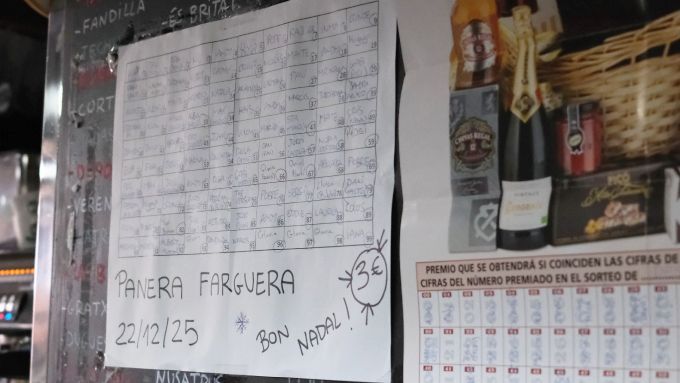
Last November, the media reported on a Barcelona bar fighting for its survival. This summer, when La Nova Farga bar (Carrer d’Almeria, Sants) requested special permission to open its terrace during the Festa Major de Sants, they learned they had an unexpected debt of 6,000 euros from the aid received during Covid-19, which had been automatically increasing. Furthermore, due to an error in the address, Ramón Puñet, the owner of the establishment, did not receive notifications, and the amount grew to 8,200 euros without his knowledge.
Today, however, the bar has not only managed to pay off its debt but has also raised over 10,500 euros. This was achieved thanks to the neighborhood and its regular customers, who encouraged Puñet to launch an online crowdfunding campaign under the slogan "Let's Save La Nova Farga," which concluded last Saturday, December 13th. Through this campaign, Puñet managed to raise the funds, much of which came directly from the neighbors. "It's been a shot of energy," assures the owner. "The neighborhood's response has been impressive, and when I saw how much people wanted us to stay, I decided that even if we hadn't reached the target, we would fight to continue in the neighborhood," he states
Problems in the sector
“When I was faced with the debt, I didn’t want to continue. I was about to close,” admits Puñet. The owner assures that, even before the problem with the 8,200 euros, he was already “discouraged” with the situation in the city of neighborhood bars or traditional bars like La Nova Farga, which have been affected by the rising cost of daily life, gentrification, and a housing crisis that is strangling the population with exorbitant rent increases. “If all prices go up, but your salary stays the same, where will you get the money for expenses? From the bar, because you can’t cut back on food at home or groceries,” explains Puñet. “It’s the same old cycle and the situation is getting worse because of how everything is,” he emphasizes
“If all prices go up, but your salary stays the same, where will you get the money for expenses? From the bar, because you can’t afford food at home or groceries,” explains Puñet
For his part, Pere Cardona, the restaurant's chef, assures that in recent years they have also seen emblematic businesses close in the neighborhood, which has set off "alarms." "The most talked-about, for me, was Terra d’Escudella. Because if they closed, despite having customers, it means something isn't working," Cardona points out.
Furthermore, Cardona insists that another of the main problems is the proliferation of establishments run by large brands, which in recent years have abandoned the peripheries to move into the neighborhood. For the chef, these are major economic competitors that often cannot be matched, leading to an increasing number of them both in Sants and throughout the city.
In this regard, Cardona particularly highlights the case of the cafeteria-restaurant l’Obrador de Casa Blanca, which now houses a McDonald's after the Sants establishment had been in the area for 20 years. "Before, McDonald's was in Collblanc and at Sants station, but now you can find it in the middle of Carrer de Sants," Cardona insists, lamenting that "what was once within a radius of action away is now in the center of the neighborhood." "We can't keep resisting and, on top of that, have a big brand placed next to us," he denounces
The neighborhood wheel
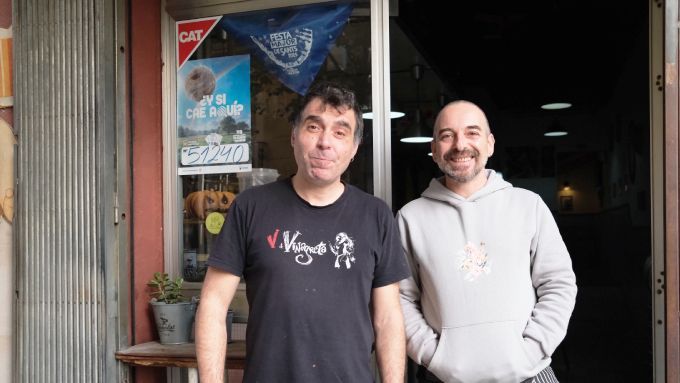
Faced with this scenario, both Puñet and Cardona advocate for neighborhood bars as spaces of resistance or even "militancy." In the case of La Nova Farga, he assures that they are spaces for the neighborhood where the customer "feels at home," and where a one-on-one relationship and empathy prevail, both towards the neighbors who frequent it and new faces. "The bar must be a space dedicated to the people of the neighborhood, from which resistance is waged and where you also strike up friendships or become colleagues with your neighbors," emphasizes Puñet. A space that, moreover, must be in opposition to the model represented by large brands with "totally impersonal" service, where "the person is served at the counter, takes their tray, and isolates themselves at the first table they find," he insists.
They also state that, in the case of La Nova Farga, they are trying to make their bar part of a network of businesses in their area that buy from each other to prevent large supermarket chains or new bakery and pastry franchises from growing at their expense. "We try to do things well and buy bread from the lifelong bakery, and have suppliers within the neighborhood," he emphasizes. In this regard, although Puñet points out that it is not a method they can apply to all products, they do try to do so, at least, with meat, bread, and cold cuts, which are local and from businesses run by neighbors. "If it's the neighborhood that has helped us not to close, I'll give it back to them in this way. In the end, it's like closing a circle," he summarizes