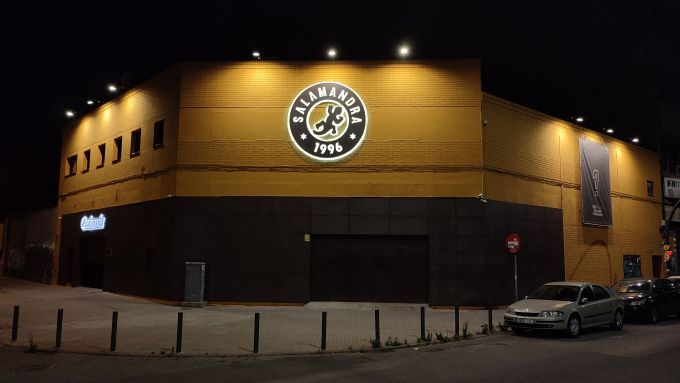
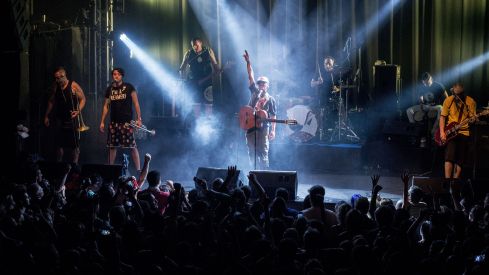
“30 years ago Los Planetas released Pop. Sónar, born in 1994, was consolidating itself as an international reference for electronic culture. In L'Hospitalet, the Sala Salamandra opened its doors. And you, where were you?”. With this declaration of intent, the concert hall at number 237 of Avinguda del Carrilet announced on social media days ago the party they will celebrate on June 18. The gathering will be a tribute to the thirty years during which Sala Salamandra has seen reference groups like Estopa or Love of Lesbian grow. Whoever wants to get a taste, can buy the t-shirt they have designed specifically for the anniversary.
One only needs to talk for a while with David Lafuente, co-founder and director of the venue, to take a trip to L'Hospitalet of 1996. “We were three friends from high school. We were 22 years old and wanted to create the alternative music club that didn't exist in our city,” Lafuente begins. At that time, L'Hospitalet had gotten rid of reference venues like A Saco Depósito Legal (which would end up being Razzmatazz). “How could it be that indie groups could be seen in a concert hall in Barcelona, but there were no venues in L'Hospitalet where they could play?”, the director shoots back. These ideas were circling in Lafuente's mind and those of two other companions, Lluís Correa and Francisco Tortosa. With them the adventure began, but after a while they got off the wagon. Soon after, Oleguer Bataller, current sound technician, and Paco Venegas, in charge of accounting, joined them. Lafuente is, from day one, responsible for the venue's programming.
10 years enduring: “We had a lot of loans”
The current director of the space summarizes with a clear idea what Salamandra represents for the music circuit of Barcelona and L'Hospitalet: “If you want to see certain groups you have to come to the periphery of Barcelona. It's what Brooklyn was for New York at the time”. And how has this venue, located in an industrial estate, achieved such fame?
In 1996, the current director of La Salamandra worked in the kitchens of a restaurant in the city center where, in fact, the name of the venue was cooked up. Thinking about what could accompany the word ‘sala’ (room), he observed the salamander, an appliance that heats dishes. On June 21 of that year, the musical project started in a venue at Avinguda Carrilet, 301, among industrial estates, because they needed “to be in an isolated area.” But the urban plans for the area forced the relocation of the business to number 235 on the same street. “We inaugurated the second room with a Muchachito concert,” recalls Lafuente.
However, the bursting of the real estate bubble halted the planned project and La Salamandra continued to program for ten years in both rooms, they assure, with great difficulty: “We juggled to hold on. We had a lot of credits.” Finally, in 2017, the machines arrived at the plot and the original room closed.
Nevertheless, throughout that decade they trained, as they point out, their musical nose: “We are a medium-sized venue, we are not Razzmatazz or Apolo, and that makes that group that hasn't blown up yet come,” points out Lafuente, who details that three decades ago, far from algorithms and the battle for followers on Instagram, they used the neighborhood music stores and catalogs called Guía de la música. “It was a guide that live music people bought because it listed contacts for managers, stage companies, equipment rentals…,” he comments.
In a store in the area, in fact, they discovered Estopa. “We went to Gong Disco, in La Farga de l’Hospitalet, and they told us that their first album was selling a lot,” recalls Lafuente. Thus, Estopa performed at Salamandra, in 2000, their first concert with a band in Catalonia, the second in Spain. More names: of the four editions of the Pop-Rock Ciutat de l’Hospitalet Contest, organized by La Salamandra with the City Council, Örn (from which Mürfila would emerge) won in 1998, Trimelón de Naranjus (from which Muchachito Bombo Infierno would emerge) won in 1999, and Love of Lesbian in 2000. The contest was stopped due to administrative obstacles with the City Council.
Over thirty years, whoever manages a music venue sees them of all colors. As they observe from La Salamandra, although the sector has professionalized, the speed with which bands grow makes it so that now some groups slip through their hands. “Before, a band released an album and you already programmed it six months in advance. Now, when you call Arde Bogotá or Ultraligera, they are already too big to come to a medium-sized venue.”, laments Lafuente.
This does not prevent the Salamandra stage from having hosted renowned national and international groups over the years. “We programmed Vetusta Morla, so if you wanted to see them in Catalonia, you had to come here”, remarks Lafuente.
Breaking with Barcelona's centrality
Another factor that makes the venue proud is that it has not only become a reference space for national groups, but also for the public of Baix Llobregat and for those from Barcelona closest to l'Hospitalet. Specifically, they recently conducted a mobility study of two thousand people (out of approximately 200,000 received per year) and have seen that one third comes from l'Hospitalet, another from various towns in Baix Llobregat, and the other third from Barcelona, specifically from the neighborhoods of Sants and Les Corts. “That they come from Barcelona breaks with the traditional mentality that those from Barcelona must always stay there. If our audience is mostly local, it is because there are people who prefer to come to a place like ours because they are more comfortable than others in Barcelona where there are many tourists”, reflects the director.
All in all, what plays at La Salamandra? From Thursday to Sunday the venue is overflowing with proposals ranging from rock, to indie, passing through pop or reggaeton. At La Salamandra there are both live tribute bands like the one this Friday evening that pays homage to Nirvana, Pearl Jam, Soundgarden and Foo Fighters, as well as the club session Zoco that, for years, floods the venue every Friday and Saturday with the pop and reggaeton hits of the moment. Another event that has recently gained fame are the so-called SBT, dance sessions held on Sunday afternoons to learn to dance bachata and salsa.
Anniversary with an expansion in sight
There is no anniversary without a good gift and Salamandra expects a big one. The venue already has the definitive municipal authorization to start an expansion of 500 square meters on the plot they bought from an old cement factory next to Salamandra. If everything progresses, the main hall will maintain its capacity of 800 people and the complex will gain a hall for concerts by emerging groups that will host up to 200 people. The works also foresee a terrace for fresh air and smoking, thus avoiding the nuisances often caused on the street. Right now, according to Lafuente, they are still waiting for permission for the machines to enter. The forecast is that the works will last between one and two years.
With a general look at the city, the venue manager celebrates being able to contribute a grain of sand to the overall project Districte Cultural, which he sees in better health than ever: “A certain musical hub is being created. In October, Village Underground Barcelona also opened here, now El Pumarejo finally returns, whom we have helped, and Sergio Caballero, one of the directors of Sónar, is creating a cultural creation center. The future growth of Barcelona passes through here,” he states.
All in all, the celebration of the thirtieth anniversary kicked off in March coinciding with the twenty years of the Lets Festival. The concert held at Sala Salamandra brought together three key bands from the Catalan and Spanish indie scene: Dorian, Sidonie and Standstill. The next date, the main one, is June 18. For now, they have already announced that Amparanoia and Joan Garriga with Madjid Fahem will visit them. The party, however, does not end in June, as it will continue between the months of October, November and December with a “special program of powerful bands”. There is no doubt, therefore, that many nights remain to be lived on Carrilet avenue.