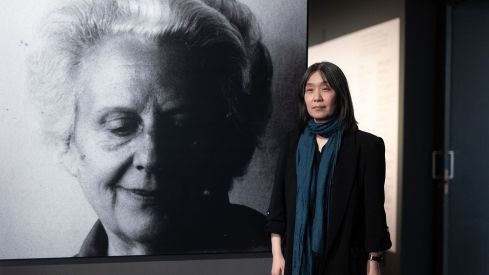
Han Kang. Ink and blood. La Magrana. (Translation by Hèctor Bofill and Hye Young Yu)
Ink and Blood is one of the first novels written by the 2024 Nobel Prize in Literature Han Kang. The story already strongly anticipates her literary universe: a writing that overflows the limits of the noir genre to merge with a thriller of poetic, philosophical, and existential character. It is not only about a generic hybridization, but about a deliberate will to destabilize the reader's expectations, who enters expecting a usual investigation and leaves after traversing a double ontological experience about pain and language. Kang does not want to explain a trauma: she wants to demonstrate the impossibility of explaining it without deforming it. In this tension —between saying and betraying— is where the entire narrative device is built. Anna Carreras i Aubets
Toni Morrison. Beloved. La Segona Perifèria. (Translation by Esther Tallada)
Sethe manages to escape the yoke of slavery that oppressed her and live with her daughter Denver in a house haunted by the spirit of her other daughter, who died nameless. The arrival of an unknown young woman and a former slave, Paul D, breaks the routine and will become a clash between the need to forget the past and its resistance to permeate everything. Toni Morrison adds another layer of cruelty to slavery, which has the perfidy of infiltrating to the bone marrow and contaminating relationships that might make one dream of the possibility of a different life. The African-American Nobel laureate invokes ghosts through a fragmented and sinuous text to show us the omnipresence of memories and regrets, that the future cannot escape the past and that peace does not come with freedom. Jordi Montell
Jon Fosse. The son. Comanegra/ Teatre Lliure. (Translation by Laura Segarra Vidal)
In May, the Teatre Lliure will premiere The son, directed by Ferran Utzet, and published within the collection «Llum de guàrdia», promoted by the same Teatre Lliure and Comanegra. With translation by Laura Segarra Vidal, the play presents an elderly couple who live isolated in a rural area, almost without contact with the neighbor, and even less with their son, an asocial and abulic young man who hasn't been home for a long time. Fosse addresses rural depopulation, not to make a social denunciation of it, but to immerse us in a placidly uncomfortable atmosphere. The text, full of repetitions, functions like a score that advances towards a final crescendo marked by the violent and dazzling irruption of the son. Bernat Puigtobella
László Krasznahorkai. Satanic Tango, Cràter Edicions. (Translation by Carles Dachs)
László Krasznahorkai, newly awarded Nobel Prize in Literature, debuted with this wonderful, sad and strange novel. Criticism tends to see in Satantango a comment on the Hungarian communist regime and the cultural, economic and moral degradation that was experienced there. Krasznahorkai takes advantage of every interview to explain that this was not his intention. At the same time, however, he warns that without understanding the political situation of communist Hungary, it will be difficult to grasp the atmosphere of the story. Krasznahorkai explains that his intention —not only with Satantango, but in much of his work— is to rediscover beauty for an art that has become incapable of continuing to seek it. Like Kafka, he has found a form that allows him to write works of a grotesque beauty, with a moral and political reading that, despite being vaporous, is intensely sensed there. Joan Rius Miralles
Grazia DeLedda, the Italian Nobel
Grazia Deledda brings us closer to wandering characters, traversed by doubt, incapable of finding a stable certainty. There is no moral code that governs them, only the fragile matter of which they are made: fears, desires, secrets and silences. As often happens with rediscoveries, reading Deledda today has something strangely contemporary. Her novels, recently recovered in Catalan now that it has been a hundred years since she won the Nobel Prize, return to us a voice that, despite writing from a rural and apparently particular context, knows how to capture with surprising precision the great conflicts of the human condition.
We read Cendra (Edicions 1984 Translation by Mercè Ubach) and Cosima (Ela Geminada. Translation by Maria Mariné), two novels that dialogue in a profound way. In Cendra, we follow the vital journey of Anania, a young man marked by an original absence: his mother, a figure who disappears and reappears like a persistent shadow, conditioning his entire existence. In Cosima, on the other hand, we delve into the childhood and youth of a Sardinian girl who discovers, with obstinacy, her vocation as a writer. The environment is structural and determining and nature acts almost as another character. Perhaps for this reason Deledda has been compared to Víctor Català: for this capacity to convert the landscape into an extension of human conflict. Cendra and Cosima are two stories that speak of growing up —or trying to—, crossed by guilt, desire, identity and, above all, by that uncertainty that never completely abandons. What Grazia Deledda does is write from a very difficult place: honesty. Alba Mallada


