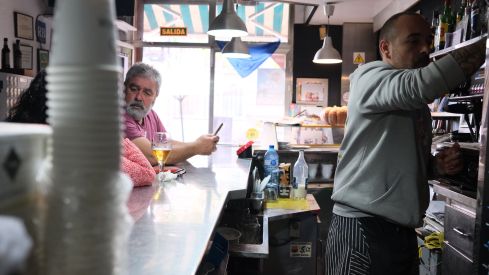
Neighborhood bars are spaces for socialization. Places that, historically, have served as essential meeting points, places of welcome, and sociability for neighborhood life. However, some voices in the sector warn that these establishments are currently in a delicate moment due to the current social and economic context.
The bars that keep your keys, collect your packages, whose owners greet you by name when you enter, and where a beer doesn't cost more than 3 euros are going through difficult times. In recent years, a series of factors have made it increasingly difficult for these businesses to stay afloat.
This is what many voices assure, such as that of the innkeeper and anthropologist Sergio Gil, who last December organized the first congress of gastronomic anthropology in Barcelona. He did so, in part, to highlight the importance of a space that "is designed for people to meet and connect" and which, beyond serving food, is "a hub of human relationships and interactions that responds to the neighborhood's need to gather, meet, chat, listen, and participate in life," he explains to AMIC Cultura.
However, on the other hand, Gil acknowledges that he moved the congress to the end of last year – originally planned for 2026 – to address the issue of the loss of these establishments and their identity in Barcelona, even though it is a reality also experienced in the metropolis. A situation caused by various factors, such as, as Gil points out, the inflation of product prices, the precariousness of the population, and the growth of a business model based on macro-cafes or "organized catering" – owned by those with five or more establishments – where only production and consumption are prioritized
Are there fewer and fewer bars?
It is difficult to quantify the loss of traditional bars with data. According to the National Statistics Institute (INE), in the last ten years Catalonia has lost 2,394 establishments of this type and Spain 19,136. The problem is that this category includes many types of businesses: bars, taverns, cocktail bars, discotheques and discopubs, breweries, cafes, juice bars, and itinerant beverage vendors. However, the classification does not distinguish between those that are neighborhood establishments or those that respond to new consumption trends.
Other data that could describe the situation of these businesses, such as the Enquesta d’Activitat del Sector de Restauració de Barcelona del 2024, show how there are fewer and fewer historic establishments in the city. Since 2014, catering businesses opened before 1979 or between 1980 and 1990 have gone from being 56% to 28% of the total. And, in a news report by El Periódico based on municipal data, the enormous turnover in the sector in the Catalan capital was shown, which has added up to 5,600 transfers of bars and restaurants and 761 new licenses in the last five years. But, at the same time, these figures do not consider what types of establishments have been born or have died: is it a new Vivari that is only interested in profit and without social character, or a traditional business that opts for a traditional style?
"The bars of a lifetime are an extension of the neighborhood and provide a public service like pharmacies and grocery stores," explains sociologist Manuel Delgado
A clear example of the latter would be Bar Gelida in Barcelona, a business with 80 years of history that in 2024 decided to open a second location called Bar Migrat to respond to the hundreds of customers – both juniors and seniors – who often queue at its doors. Or, even, the transfers of neighborhood bars to members of the Chinese community – who, according to the previous survey, own 15% of the establishments analyzed – who in recent years have taken the reins of many bars on the verge of closure due to a lack of generational succession and who, in the new phase, usually maintain the same dishes and the same community
So, the situation of the neighborhood bar still has many nuances and, in fact, it is a term that responds more to sociology than to the legal framework, which "falls short," according to Gil, to talk about such a broad social phenomenon.
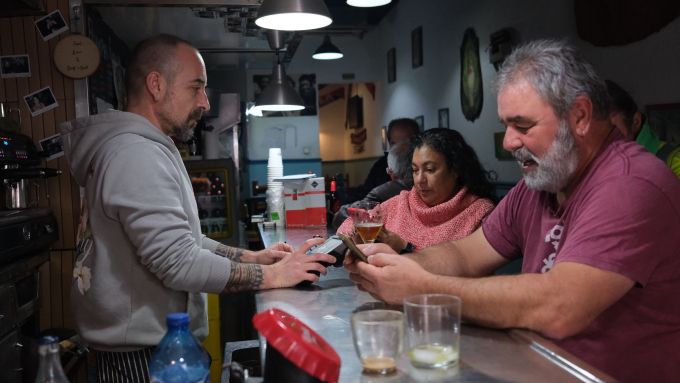
“An institution”
According to sociologist Manuel Delgado, neighborhood bars or traditional bars are establishments that have become "an institution of local social life." "They are bars where a certain type of clientele has seen them as the most suitable setting for a type of sociability that is their own or that resembles them more," he points out. Broadly speaking, he adds, they are spaces where their clientele "finds a recognizable and friendly atmosphere."
However, Delgado points out that these are establishments "directly linked to the personality of their neighborhood," although, paradoxically, they should not have "any pretension of their own personality." And, in fact, people tend to frequent them because they are the closest to home – *the neighborhood ones* – and they end up becoming a meeting point. "They are an extension of the neighborhood and serve public functions like pharmacies and grocery stores," he emphasizes.
On the other hand, however, there are those establishments that "either you can't go to or you don't feel like going to," the sociologist points out, referring to those that are "openly for *hipsters*." They tend to be located in tourist areas and seek "a more solvent and enriched demand, like that of tourists." In this regard, he points out that these are businesses dominated by the market and, therefore, are the ones that opt for more profitable models that dispense with the usual clientele – the ordinary worker and the student trying to spend as little as possible, for example – and with popular prices.
For his part, Gil insists that they are establishments based on mass consumption and that "they are not designed to care for or house the surrounding community, their neighborhood." Therefore, we are talking about spaces that have left behind one of the fundamental aspects of what, for Gil, a bar should be: social spaces, for socialization and welcome, that are an active part of the neighborhood's daily life.
The Bars Speak
Beyond the theoretical framework, when we ask different neighborhood bars in the metropolis what it means to be one of these local establishments, the answers vary. Sandra García, third-generation co-owner of Bar La Patata (1955) in Cornellà, believes it implies a "family atmosphere that functions exactly the same" as when her grandfather took it over. "You speak to the regulars on a first-name basis, you know what they want without asking, and you know them and their lives," she emphasizes. A space that, for 70 years, García assures has functioned as a meeting place for workers from the surrounding factories. "In the 50s there were few bars and restaurants, and humble people celebrated communions, baptisms, weddings here, or simply had coffee before going to work," she points out. "Some of the customers who come in tell me they were here when they were young, and they always ask about my grandfather," she adds.
"Most of our clients are working-class people, and if we raise prices, they simply won't come," assures Sandra García, co-owner of Bar La Patata in Cornellà
La Nova Farga (2014), in the Sants neighborhood of Barcelona, despite being a newer establishment, believes they are that bar "dedicated to the people of the neighborhood, from where you resist and also where you strike up friendships or become colleagues with your neighbors," assures owner Ramón Puñet. "It's a place where you feel at home," he insists. An establishment that contrasts with the dynamics of large chains, which have "totally impersonal treatment and where they serve you at the checkout, you take your tray and isolate yourself at the first table you find," he adds.
For their part, at Bar Boxes (1982) in Badalona, they describe themselves as "a family bar." "Our usual service is friendly, and when someone starts coming, you build trust and there's more complicity," explains the second-generation owner, David Segura.
However, all three locals point out that it is increasingly difficult to run a bar. "Before, my parents, just the two of them, made much more profit than my brother and I do now," laments García. Along these lines, the owner of La Patata assures that "raw materials have become much more expensive," but they cannot raise prices in the same way. "Most of our customers are working-class people, and if we raise prices, they simply won't come," he says
La Nova Farga has also observed this price increase and, in fact, they explain that they notice that customers are increasingly precarious due to stagnant wages and a rental crisis that is squeezing the population. "If all prices go up, but your salary stays the same, where will you get the money for expenses? From the bar, because you can't cut back on food at home or groceries, which are also getting more expensive," Puñet adds.
In addition, both García and Puñet see how the usual bars and surrounding establishments have been replaced by new businesses or large brands. "Before, McDonald's was in Collblanc and at Sants station, but now you find it in the middle of Carrer de Sants," exemplifies Pere Cardona, chef at La Nova Farga.
Neighborhood bars are aware that they are going through a difficult time, but they assure that they must fight to preserve their human and proximity factor. "They are part of the cultural heritage and extremely important social spaces, and if we lose these bars, our lives end," Gil concludes
Caring for Tradition
“We make Catalan cuisine out of militancy and for no other reason. Because if not, the easiest thing would be to do what everyone else does, frozen and fast food, which seems to be more popular now,” states Pere Cardona, chef at Bar La Nova Farga (2014) located in the Sants neighborhood, Barcelona.
In fact, Cardona defends that the cuisine "of the Catalan Countries has always been fought for, and continues to be fought for, in bars" and that, for him, doing so not only represents a movement of resistance against an increasingly frenetic trend of mega-cafes and restaurants run by large franchises, but also to "preserve the cultural and gastronomic heritage of Catalonia".
In this regard, one of the types of Catalan cuisine that is now gaining more and more traction is undoubtedly the "esmorzar de forquilla" (fork breakfast). Both throughout Catalonia and in the metropolitan area, "the 'esmorzar de forquilla' is experiencing a very sweet moment because it is attracting consumers who are embracing it from a recreational and enjoyment perspective," explains Rafa Gimena, journalist, sommelier, and coordinator of the Lliga del Port i la Forquilla 2025. Thus, while the journalist points out that in urban areas like the metropolis, the Catalan plate breakfast has to compete with proposals like brunch, he assures that a trend has been detected where fewer three-course dinners are being served, and, conversely, groups of breakfast-goers who opt to do this Catalan tradition two or three times a week are gradually increasing. "It has been a social change that dates back to COVID, and the current state of salaries has also influenced it: a gastronomic Saturday night dinner can cost you up to 120 euros if you go with someone, but with that same amount, you can have 'esmorzars de forquilla' all week long," Gimena emphasizes.
Furthermore, the journalist believes that the aging population is also contributing to more retirees frequenting traditional bars and their communities, which tend to have these breakfasts. "Barcelona is very diverse, and it's not just Eixample or Raval," the expert insists, adding that the Catalan capital "still has many neighborhoods and areas that are like many cities or towns in the rest of Catalonia, where they have an entire community centered around bars. If the daily offering is hearty breakfasts, many people will opt for that habitually," he concludes.


